Abstract
C3.ai, Inc. will issue its financial results for the fiscal first quarter, which ended July 31, 2026, following the close of the U.S. markets on Wednesday, September 2, 2026.
Market Forecast
The market’s current baseline for the quarter is revenue of 52.12 million US dollars, a year-over-year decline of 44.90%, with an estimated EPS of $-0.25 (year-over-year change of -26.31%) and estimated EBIT of -44.24 million US dollars (year-over-year change of -25.50%).
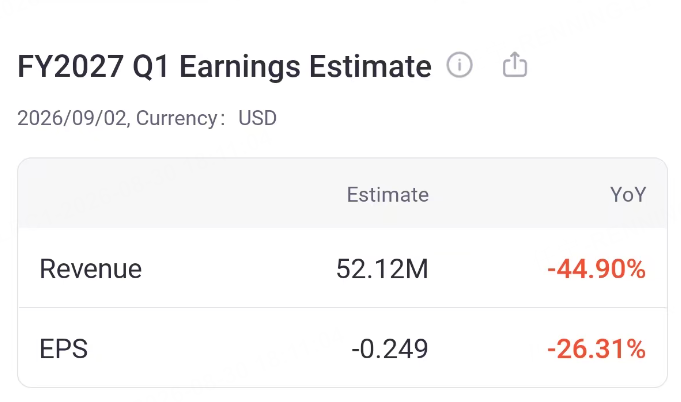
Forecasts for gross margin and net margin are not broadly disclosed; the focus is on whether operating losses narrow as subscription mix stabilizes and cost reductions flow through. In the core subscription business, expectations center on steady conversion of pipeline to revenue and contract renewals that anchor near-term billings; the most promising activity remains in government-aligned use cases where bookings have shown robust growth, setting up potential future revenue ramp as deployments progress from initial production to broader rollouts.
Main business highlight: subscription remains the foundation, with management commentary and prior-quarter mix showing most revenue driven by subscriptions, while services support implementation and early-stage deployments. Most promising segment: Federal, Defense and Aerospace programs, with bookings previously reported to be a majority share and up triple-digits year over year, suggesting a medium-term revenue catalyst once deployments scale and convert.
Last Quarter Review
In the prior quarter, C3.ai, Inc. delivered revenue of 51.30 million US dollars (down 52.82% year over year), a gross profit margin of 21.94%, a GAAP net loss attributable to shareholders of -0.12 billion US dollars (net profit margin of -223.97%), and adjusted EPS of -0.33 (year-over-year change of -106.25%). Notably, GAAP net profit improved sequentially by 13.34% on a quarter-on-quarter basis despite remaining negative, reflecting initial benefits from restructuring and operating discipline alongside a subdued revenue base. By business line, subscription revenue was 48.38 million US dollars and professional services revenue was 3.22 million US dollars; while the company did not disclose segment-level year-over-year rates, total revenue contracted by 52.82% year over year, underscoring the near-term growth challenge as management prioritizes pipeline qualification, disciplined deal intake, and cost control.
Current Quarter Outlook (with major analytical insights)
Subscription Revenue and Renewals
The subscription engine is the near-term determinant of reported revenue stability and margin trajectory this quarter. With consensus revenue at 52.12 million US dollars, the bar implies modest sequential improvement against the prior quarter’s 51.30 million US dollars, but a sharp year-over-year contraction due to mix, deal pacing, and tighter intake standards. Investors will look for evidence that renewal behavior remains stable and that subscription billings conversion to recognized revenue is holding as enterprise deployments progress from pilot phases to production. The degree of price discipline and contract duration will also matter because multi-year agreements underpin visibility and reduce quarter-to-quarter volatility.
A meaningful portion of contracts is tied to implementation milestones and customer acceptance, which can shift revenue timing by weeks or months. Commentary around deferred revenue movements and remaining performance obligations will therefore be scrutinized as a proxy for forward subscription health. If deferred revenue grows sequentially and net dollar retention stays resilient, it would suggest that the pipeline is converting and that the subscription base can sustain the projected revenue level despite a cautious macro backdrop. Conversely, any signal of elevated churn or shorter contract duration would raise questions about the sustainability of current forecasts.
From a profitability perspective, a higher subscription mix is typically margin accretive relative to services. If the company can preserve subscription revenue around the guided level while maintaining implementation efficiency, gross margin should hold in a range comparable to recent levels even if quarter-to-quarter fluctuations persist. The direction of operating expense run-rate post restructuring will be just as important in framing the path to narrower losses in the second half of the fiscal year.
Government-Related Programs and Bookings Conversion
Federal, Defense and Aerospace programs have recently delivered strong bookings, previously accounting for the majority of bookings with year-over-year growth exceeding 100%. This segment offers durable pipelines and potentially larger multi-year deployments once initial production deployments (IPDs) convert to enterprise-wide rollouts. The key question this quarter is how effectively these wins translate into recognized revenue given elongated procurement cycles, phased acceptance criteria, and the complexity of mission-critical environments.
The company’s reported quarter included multiple IPD wins and conversions, highlighting growing traction across government customers. For near-term results, however, revenue recognition depends on progress milestones, which can vary by program and customer, making timing unpredictable at the individual account level. Thus, management’s color on the number of IPDs converting to broader deployments—and the cadence of related revenue recognition—will be an important leading indicator. A modest sequential uptick in services revenue tied to implementations could precede larger subscription ramps as solutions move from pilot to production.
In addition to revenue timing, the mix of government programs can influence working capital due to billing schedules and acceptance testing. Clarity on billings and collections within these projects will help investors assess cash usage against the company’s ample cash and investments base. If management outlines a pipeline of conversions slated for the coming two to three quarters, the market may look through near-term volatility and assign higher confidence to revenue stabilization into the fiscal second half.
Key Stock Price Drivers This Quarter
The stock’s performance into and through the print will likely pivot on three variables: revenue mix and stability, operating expense discipline, and the quality of forward-looking commentary. On revenue, the consensus embeds a modest sequential increase; an in-line outcome accompanied by firm guidance or constructive qualitative commentary could temper concerns around the steep year-over-year decline. Any upside surprise driven by earlier-than-expected conversions or stronger renewals would be incremental, but the bar on absolute growth remains cautious due to the deliberate pacing of deal intake and a focus on higher-quality engagements.
Operating expense discipline following restructuring is central to the path of loss reduction. The last quarter’s quarter-on-quarter improvement in GAAP net profit, despite ongoing losses, suggests initial traction; the Street will look for reinforcement via lower non-GAAP operating loss, clearer run-rate savings, and signals that hiring and discretionary spend remain aligned with revenue reality. If operating losses narrow in tandem with steady subscription revenue, the narrative can pivot toward operating leverage developing later in the fiscal year.
Lastly, forward commentary will be as influential as reported figures. Investors will track management’s language around remaining performance obligations, deal velocity, and the pace of IPD-to-production transitions. Credible framing of the next one to two quarters—particularly around bookings conversion, services-to-subscription ramp profiles, and cash burn cadence—will anchor sentiment. Any update on leadership alignment and go-to-market structure, including responsibilities across the executive team, would also help the market interpret execution risk and the durability of cost actions already taken.
Analyst Opinions
Most recent published views lean cautious. A notable example is Canaccord Genuity, where analyst David Hynes reiterated a Hold rating with a 10.00 US dollars price target, reflecting neutral positioning ahead of the print and an emphasis on monitoring revenue stability and operating loss trends. Preview notes circulating in the market similarly emphasize a guarded stance, highlighting the consensus call for revenue of 52.12 million US dollars (down 44.90% year over year) and negative EBIT of 44.24 million US dollars, with attention on whether restructuring and tighter deal screening can meaningfully curb losses.
Cautious viewpoints tend to converge on three themes. First, while bookings in select verticals are robust, the translation to recognized revenue can be uneven, making quarter-level forecasting challenging. Second, the company’s gross margin last quarter at 21.94% and net loss margin of -223.97% underscore that the path to profitability relies on both higher subscription mix and sustained operating discipline. Third, investors want better visibility on the timing and magnitude of IPD conversions to broader deployments—particularly in government-related programs—to underwrite stabilization or recovery in year-over-year revenue comps. In sum, the majority stance is to wait for clearer proof of revenue stability and loss normalization across the next set of quarters rather than anticipate a near-term inflection in the upcoming print.