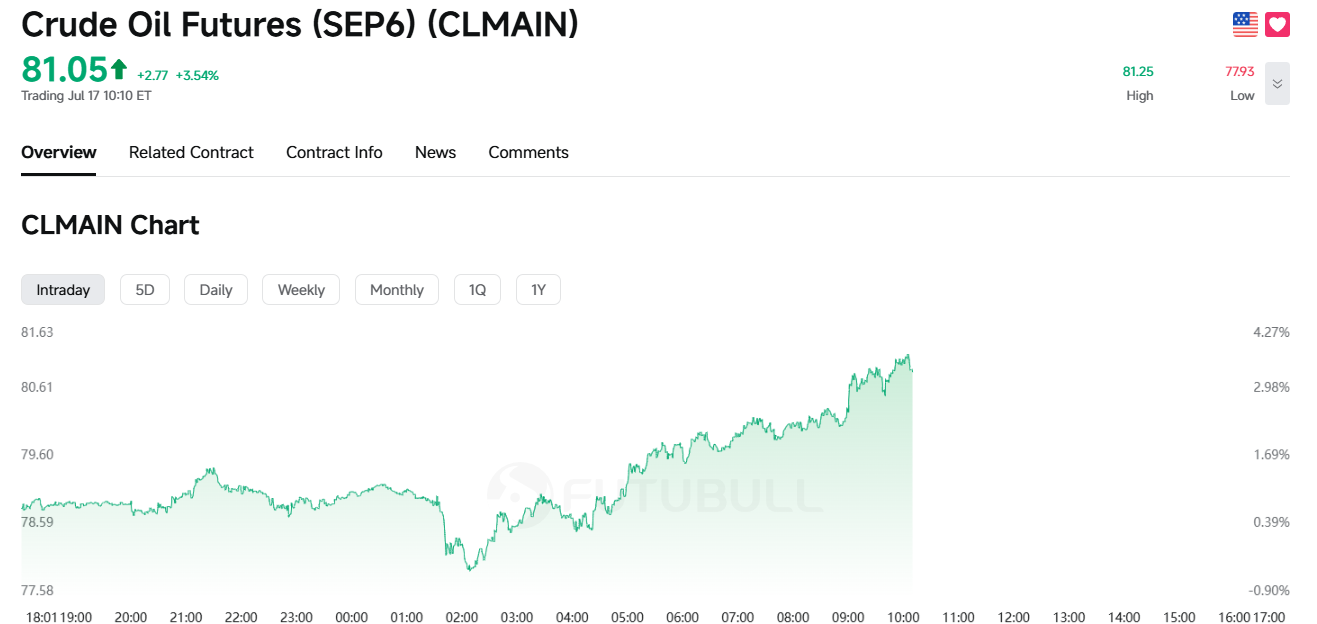
Tradingkey - On July 17, Eastern Time, the US-Iran conflict continued to escalate, with the two major crude oil futures rising again, returning to mid-June price levels. As of press time, WTI crude oil futures rose over 3% to $81.05, while Brent crude oil futures also climbed over 3% to $87.01.
Source: FutuBull
Iran's Revolutionary Guard issued another statement: In response to the aggressive actions of the US military, we struck the US military's special operations command center at the Al-Tanf military base in Syria, destroying a radar system and multiple helicopters used for special operations, resulting in the deaths of US military personnel. Iran remains in complete control of the Strait of Hormuz, and as long as US aggressive actions continue, not a single drop of oil or natural gas will be exported through this region.
Meanwhile, the US has launched airstrikes against Iran for the sixth consecutive night. US Central Command stated last night that it has completed its latest round of large-scale strikes against Iran, hitting dozens of military targets, including air defense systems, logistical infrastructure, and maritime operational capabilities.
As the fragile ceasefire agreement signed between the US and Iran last month shows further signs of fracturing, the confrontation between the two sides continues to escalate.
Rising energy transportation risks have become an important support for oil prices. The Strait of Hormuz accounts for approximately 20% of the world's seaborne crude oil, while the Red Sea, connecting to the Suez Canal, serves as an energy hub linking Europe and Asia. If both key channels are disrupted simultaneously, it will aggravate global crude supply disruptions and push up market risk premiums.
Currently, vessel transits through the Strait of Hormuz have decreased, and some shipping companies are choosing to reroute, pushing up both freight costs and insurance premiums, which reinforces expectations of tighter supply. Although there are no significant changes in global crude inventories or production from major oil-producing nations for now, shipping-side uncertainties have become the core driver of rising oil prices.
The market is currently focusing on the evolution of the Middle East situation and the direction of oil price range breakouts: a deteriorating situation will open up room for oil prices to rise further, while easing tensions could trigger a pullback in risk premiums.
Find out more