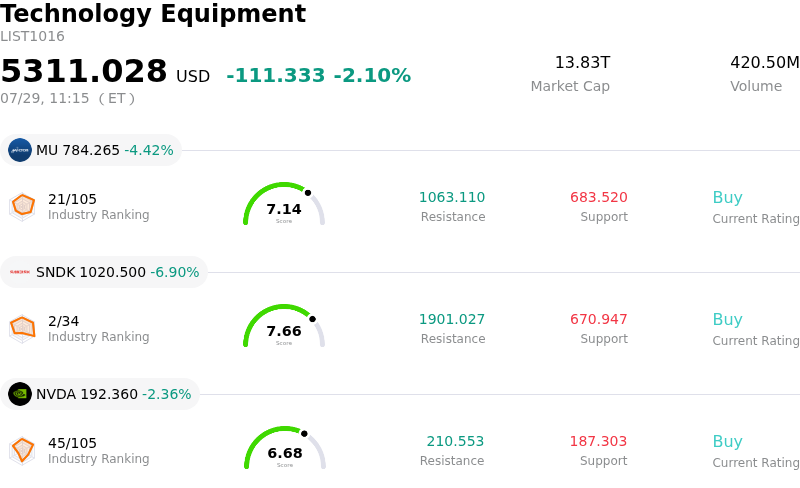
Taiwan Semiconductor Manufacturing Co Ltd (TSM) moved down by 3.31%. The Technology Equipment sector is down by 2.10%. The company underperformed the industry. Top 3 stocks by turnover in the sector: Micron Technology Inc (MU) down 4.42%; SanDisk Corporation (SNDK) down 6.90%; NVIDIA Corp (NVDA) down 2.36%.
What is driving Taiwan Semiconductor Manufacturing Co Ltd (TSM)’s stock price down today?
The downward pressure on Taiwan Semiconductor Manufacturing Company today is primarily driven by a combination of macroeconomic headwinds and sector-wide profit-taking. Recent signals from the Federal Reserve suggesting a prolonged period of elevated interest rates have dampened investor enthusiasm for high-valuation technology stocks. As a bellwether for the global semiconductor industry, the company is particularly sensitive to changes in the discount rate applied to future earnings, leading to a noticeable retreat in its market valuation as capital rotates toward more defensive sectors.
Beyond macro factors, industry-specific concerns regarding the pace of AI infrastructure investment are weighing on sentiment. While the long-term outlook for advanced packaging and high-performance computing remains robust, short-term fatigue is setting in as investors question the immediate return on investment for major cloud service providers. This caution has been exacerbated by recent reports suggesting a potential normalization of inventory levels across the broader consumer electronics segment, raising fears that the explosive growth seen in previous quarters may be reaching a temporary plateau.
Geopolitical considerations continue to provide a baseline of volatility for the stock. Renewed rhetoric regarding trade restrictions and technology export controls has heightened the perceived risk profile of companies with significant footprints in East Asia. Even with ongoing efforts to diversify manufacturing capacity into the United States and Europe, the concentration of the firm's leading-edge nodes in Taiwan leaves it exposed to regional instability, prompting institutional desks to trim positions as a precautionary measure amid shifting global diplomatic dynamics.
Technical factors and institutional portfolio adjustments are also at play. Following a period of sustained outperformance, the stock has encountered significant resistance, triggering automated sell orders as it broke through key support levels. The increased volatility is further reflected in the options market, where a rise in hedging activity suggests that traders are bracing for continued uncertainty in the lead-up to the next round of major tech earnings. For long-term investors, this pullback represents a reassessment of risk premiums rather than a fundamental shift in the company's dominant competitive position in the foundry market.
Technical Analysis of Taiwan Semiconductor Manufacturing Co Ltd (TSM)
Technically, Taiwan Semiconductor Manufacturing Co Ltd (TSM) shows a MACD (12,26,9) value of -7.023, indicating a sell signal. The RSI at 38.989 suggests neutral condition and the Williams %R at 83.416 suggests oversold condition. Please monitor closely.
Fundamental Analysis of Taiwan Semiconductor Manufacturing Co Ltd (TSM)
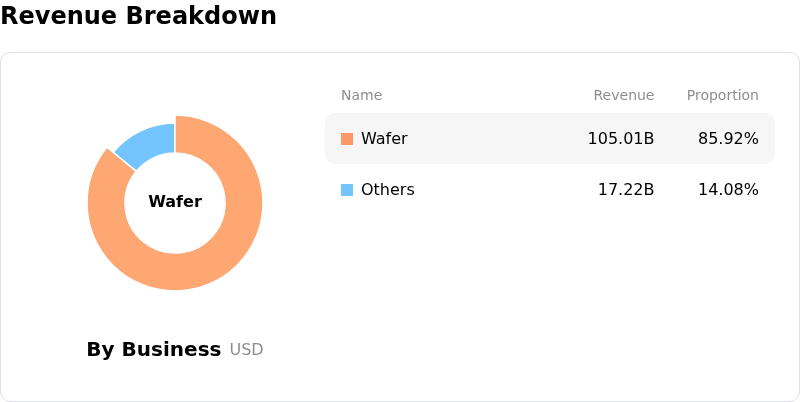
Taiwan Semiconductor Manufacturing Co Ltd (TSM) is in the Technology Equipment industry. Its latest annual revenue is $122.22B, ranking 2 in the industry. The net profit is $55.12B, ranking 2 in the industry. Company Profile
Over the past month, multiple analysts have rated the company as Buy, with an average price target of $532.10, a high of $700.00, and a low of $363.80.
More details about Taiwan Semiconductor Manufacturing Co Ltd (TSM)
Company Specific Risks:
- Geopolitical and Trade Policy Vulnerability: Recent political rhetoric regarding the defense of Taiwan and potential "protection fees," alongside reports of expanded U.S. Foreign Direct Product Rule (FDPR) restrictions, have heightened the risk of severe trade barriers that could disrupt the company's global supply chain and revenue from the Chinese market.
- AI Revenue Concentration and Demand Sustainability: Institutional analysts are increasingly concerned about the high concentration of revenue derived from a small group of AI chip designers; any reduction in capital expenditure from hyperscalers or a slowdown in AI infrastructure deployment would disproportionately impact the company’s fabrication utilization rates.
- Margin Pressure from Advanced Node Escalation: The aggressive ramp-up of 2nm process technology and the integration of High-NA EUV lithography involve massive capital expenditures and higher operational costs, posing a significant risk to gross margin stability if yield rates or volume commitments from primary customers fail to meet internal targets.
- Geographic Concentration and Execution Risk: Despite international expansion projects in Arizona and Japan, the vast majority of the company's advanced manufacturing remains centralized in Taiwan, exposing the firm to localized systemic risks such as seismic events or regional instability that could lead to catastrophic production halts.
Find out more