TradingKey - At Friday's close in US Eastern Time, WTI crude oil prices (USOIL) tumbled 5.58% on the day, once again losing the $100 mark to settle at $95.46. Middle East supply disruptions had previously pushed WTI close to $107, but as expectations grew for a partial restoration of Saudi oil pipelines and diplomatic mediation increased, oil prices fell for three consecutive trading sessions.
Oil May First Trade 'Negotiation Expectations' on Monday as Iran Proposes 7 Conditions for Peace Talks
Mohsen Rezaei, Secretary of Iran's Supreme National Security Council, said Saturday that Iran has conveyed seven conditions to the U.S. via Qatar to initiate negotiations and is currently awaiting a response from U.S. President Donald Trump. Only three conditions have been publicly disclosed so far, including ending war on all fronts, releasing frozen Iranian funds, and ending the U.S. naval blockade, with the remaining conditions yet to be revealed.
From a market perspective, Iran's proactive proposal of negotiation conditions indicates that diplomatic channels remain open. If the U.S. side does not directly reject them over the weekend while Qatar and Pakistan continue mediation efforts, the market may price out part of the Middle East supply disruption risk premium. Similar situations have occurred multiple times before: whenever U.S.-Iran negotiations make substantive progress, oil prices typically give back part of the geopolitical risk premium quickly. In July, when prospects for U.S.-Iran talks improved, oil prices fell to multi-month lows; in August, after Trump paused further military action against Iran, crude also plunged around 7% in a single day.
Therefore, if there are no new military conflicts before Monday's open and the U.S. does not explicitly reject Iran's conditions, WTI crude could open lower or extend last Friday's losses, with the market likely trading the expectation of "renegotiation" first.
However, downside room for oil prices may be temporarily limited, as Iran is not proposing an unconditional resumption of talks. Rezaei also warned that if the U.S. rejects the conditions, Iran is prepared for a so-called "decisive war," adding that fresh U.S. military strikes remain a possibility. Iran also stated that its military plans have already taken into account U.S. naval assets in the Persian Gulf, the Gulf of Oman, and the Arabian Sea.
Currently, if the U.S.-Iran situation does not escalate further over the weekend, WTI may face initial downward pressure at Monday's open and test around $90; however, if the U.S. explicitly rejects Iran's conditions, or if attacks targeting oil tankers, oil facilities, or U.S. military targets recur in the Middle East, oil prices could reverse quickly and move higher again.
WTI Crude Oil Price Technical Analysis
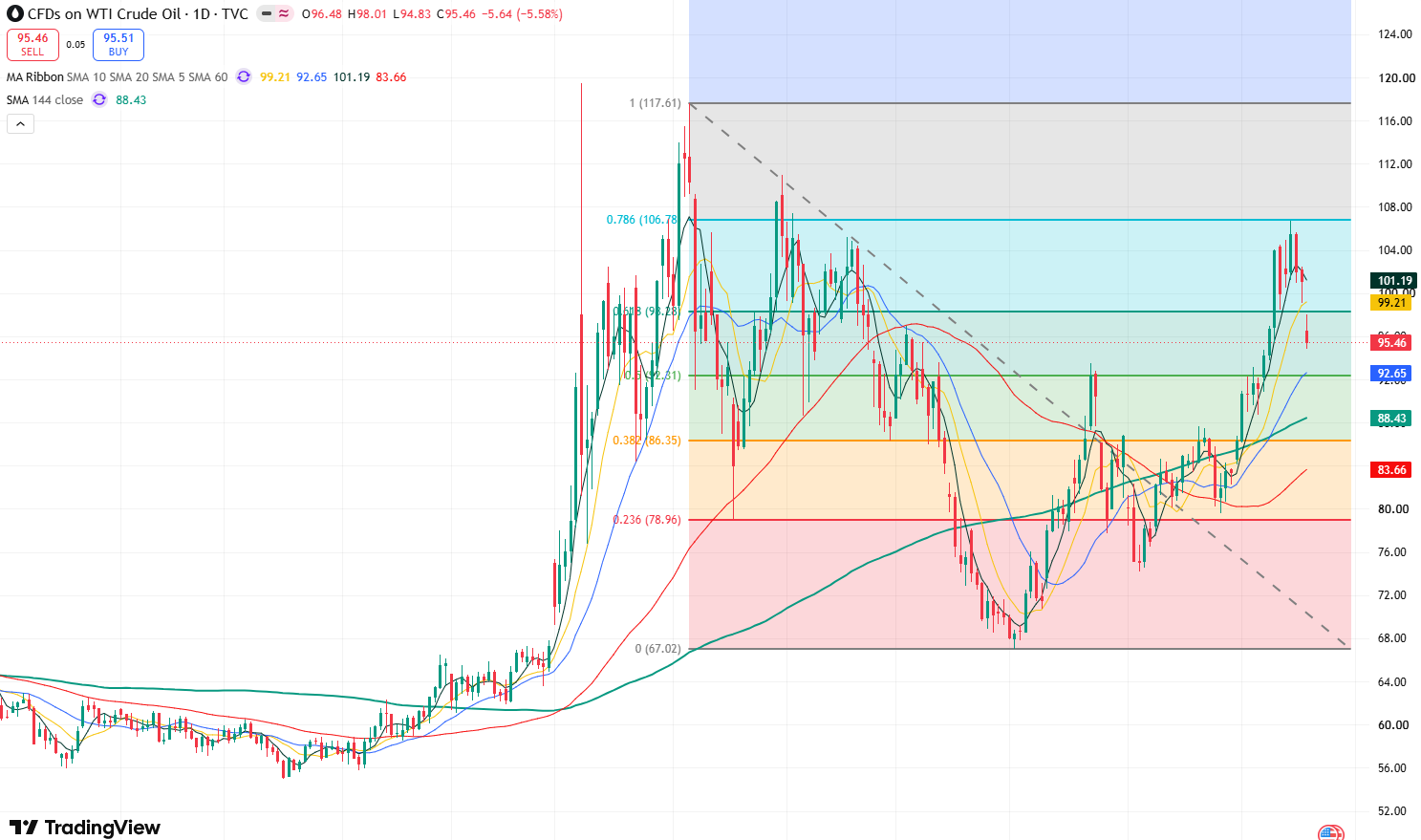
WTI Crude Oil Daily Chart, Source: TradingView
Looking at the daily chart of WTI crude oil prices, recent prices came under pressure and pulled back after rebounding below $106.80, falling for three consecutive trading days and briefly breaking below the $100 mark, indicating that bears are currently dominating market sentiment.
Currently, as oil prices broke below $100, further downside room has opened up. The primary downside target will be testing the $92 support level, followed by the $90 mark below. If this level fails to hold, oil prices may fall further toward the support level near $85.
On the upside, the primary resistance level above is at $98-$100. If prices can regain a solid footing above $100, oil prices will continue to challenge the resistance level at $106.80. A strong push above $106.80 could see oil prices test $110-$111.
Find out more