TradingKey - On September 18 ET, cryptocurrencies broadly rose today, with Bitcoin (BTC) gaining 6% and breaking above the $80,000 mark; Ethereum (ETH) rose 5.62% to $2,587; Ripple (XRP) gained 7% to $1.38.
The market pointed to regulatory progress as the main catalyst for this rally: the U.S. Commodity Futures Trading Commission (CFTC) has submitted a new regulatory proposal for crypto asset trading and markets to the White House for review, turning to accelerate rulemaking under existing authority after a digital asset bill failed to advance in the Senate this week.
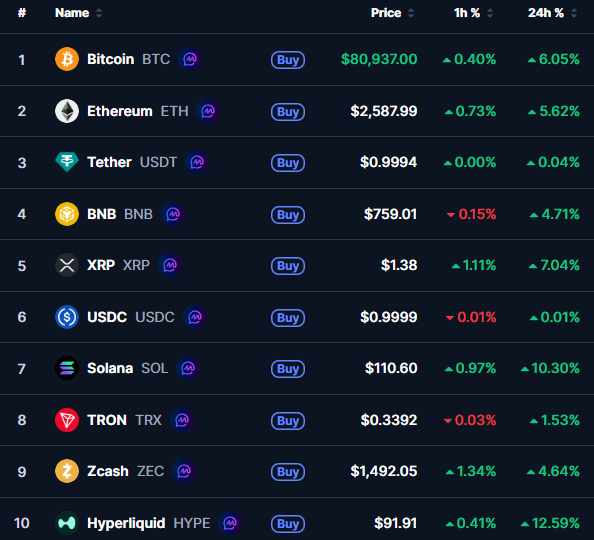
Price changes of the top 10 cryptocurrencies by market capitalization, Source: CoinMarketCap
Information published by the White House Office of Management and Budget (OMB) on Friday shows that the proposal was received on Thursday (September 17) and entered the review process. The proposal is currently in the 'prerule' stage, a preparatory phase prior to formally issuing proposed rules, with specific details not yet disclosed and public comment periods as well as effective dates remaining undetermined.
The digital asset bill's failure to advance in the Senate this week means that the path to establishing a market rule structure for crypto through legislation has been delayed once again. For regulators, rather than waiting for legislation to pass, it is better to use existing legal authority to construct a regulatory framework for trading, clearing, and market oversight—this is the core logic behind the market's interpretation of the proposal and the reason prices reacted in advance.
Under the current process, after the OMB completes its review and makes potential revisions, it will return the proposal to the CFTC for a commission vote. Subsequently, the agency will solicit public comments on the proposal, incorporate the relevant content into a final version, which will require another commission vote to take effect. In other words, the proposal remains at the very beginning of the rulemaking chain.
The core variable long suppressing the crypto industry has been 'regulatory ambiguity'. Progress on the executive route implies that regulatory boundaries are expected to be clarified sooner, making the compliance prerequisites for institutional capital entry more predictable; compared to 'waiting for another legislative cycle', the timeline for administrative rulemaking better aligns with trading-level pricing preferences. This is also the direct reason why risk appetite rebounded and crypto assets alongside related concept sectors strengthened in tandem following the announcement.
Find out more