TradingKey - As Meta Platforms (META) continues expanding its AI-powered products, we take a look at the company’s performance so far and where it is heading in the future. META ended October 8 at $720.89, down 0.06% on the day, and down 2.38% the day prior. It is currently valued at around $1.84 trillion.
Although its strong core advertising business continues to fuel the company and increase daily engagement, its infrastructure spending takes away from those positives. In Q2, Meta reported $31.08 billion of capital expenditures, including finance-lease principal payments, which negatively impacted its free cash flow. AI is making suggestions and recommendations better as well as improving ad targeting.
Meta Blocks TikTok Ads as Competition Intensifies
There has also been recent company-related news as Meta revealed it will no longer allow ads from TikTok’s parent company, ByteDance, in the U.S. and other countries including Egypt, Indonesia, Japan, Thailand, Vietnam, and Canada, starting October 8.
The restriction also applies to any third-party ads that send users to TikTok and other ByteDance apps. Meta believes it has no obligation to provide promotional services to a direct competitor that ultimately steers users away from its platform.
While the financial impact of the loss of ByteDance ads is not major, strategically it reinforces Meta’s focus to protect users’ attention and appeals to younger audience members who are drawn more to TikTok and other platforms rather than Instagram.
Muse Is Becoming Meta’s Most Important New AI Product
The more significant development for the investment case is Muse, Meta’s personal AI agent. Meta released Muse on September 8 as an assistant to help users complete tasks such as sending emails and booking travel. The assistant will help Meta achieve Zuckerberg’s goal of developing what Meta calls “personal superintelligence.” According to Reuters, the free and paid tiers of Muse offer access to a variety of integrations across email and calendar apps as well as payments, shopping and other services.
Muse’s popularity has been surprising. In late September, Citigroup estimated that by 2030, Muse could generate over $27 billion in annual revenue. While this estimate is an analyst forecast and not Meta’s guidance, I would consider this to be an upside case scenario.
I see Meta’s advantage in distribution to be the most important. As Reuters reported, with its existing user base across WhatsApp, Instagram, Messenger, and Facebook, Meta has the edge over rival AI companies, as it can distribute and market Muse across an existing audience of billions rather than building a separate user base from scratch.
Muse Could Create a New Commercial Layer
Going beyond subscriptions, there are opportunities to monetize Muse in other ways. For example, if people start asking Muse what to buy or where to go, Meta could create a new layer in its advertising model based on commercial intent.
This could be strategically powerful, as Meta has a lot of behavioral and interest data in its social platforms. With a personal agent that helps people transact, Meta could establish a new means of commerce and advertising that relies more on performance and affiliate ad revenue.
A major risk with this could be user trust. Reuters already reported that AI agents raise many privacy and reliability concerns, and there are reports that show that Meta’s agents have had access to very sensitive data. If Meta is aiming to have Muse serve as the “front door” to the internet, they will have to make sure users are comfortable trusting the assistant to help with sensitive transactions.
Advertising Growth Remains Exceptionally Strong
Meta’s 2Q results demonstrated that the core business is still growing. Revenues were up 28% year over year to $60.80 billion, with advertising revenues up 27% to $59.36 billion. Family of Apps’s total ad impressions was up 14%, and average price per ad was up 12%.
Family daily active people was 3.60 billion, an increase of 3% year over year. Improvements in ad systems have allowed advertisers to improve the return on their ad spend, and coupled with Meta’s improvements to content ranking, have resulted in longer user engagement and higher prices without adversely impacting the demand for ads.
For Q3, total revenues are expected to be in the range of $61 to $64 billion. Foreign exchange is expected to negatively impact revenues by about 1% year over year.
AI Spending Has Become the Main Financial Risk
Many analysts are now less concerned with whether or not Meta is able to generate revenue, and more concerned with how much capital the company is going to need to invest in AI in order to stay competitive.
Capital expenditures including finance-lease principal payments for the 2026 fiscal year are expected to be between $130 billion and $145 billion. Q2 capital expenditures and finance-lease principal payments were $31.08 billion. Operating cash flow was $31.86 billion. As a result, free cash flow for the quarter was just $784 million, down from $8.55 billion in the same period last year.
As the CFO pointed out, this capital expenditure spending is necessary to maintain their market position. As of June 30, 2026, Meta had cash, cash equivalents and marketable securities of $90.26 billion. The question is whether or not the improvements will be financially justified in the end.
Meta’s Iris Chip Could Improve AI Economics
Meta is also developing its own AI silicon to decrease its reliance on external suppliers. According to Reuters, Meta planned to begin producing its Iris AI chip in September after successful testing.
The chip is part of Meta's MTIA program. Meta also uses large quantities of Nvidia and AMD hardware and plans to deploy about 7 gigawatts of computing infrastructure in 2026, increasing total computing capacity to around 14 gigawatts in 2027.
If Iris is a success, others may be inclined to develop in-house AI chips. This could further change the AI economics landscape by allowing companies to decrease their reliance on costly third-party chips. Meta may also see changes to its cost structure, but it will take some time for in-house chips to represent a large enough portion of compute to significantly impact its bottom line.
Reality Labs Still Burns Billions
Reality Labs continues to be a huge financial drain. In Q2, Reality Labs’ revenue was only $431 million, while its operating loss was $4.62 billion. The first half of the year operating loss was roughly $8.65 billion.
Smart glasses are the most commercially viable part of this business, but growing privacy concerns are coming to the forefront. A major Dutch eyewear chain recently stopped selling Ray-Ban smart glasses due to growing public concerns around camera-equipped wearables.
While Meta continues to develop various new form factors of augmented and virtual reality equipment, including reports around camera-less smart glasses, the financial drain remains the same. Reality Labs continues to drain Meta billions, while Meta concurrently funds what is believed to be the largest AI infrastructure program in history.
Regulatory Pressure Is Becoming More Expensive
Regulatory exposures are another significant risk. On October 6, the UK regulator Ofcom began its first formal investigation under the Online Safety Act into Meta to assess whether the company assessed safety risks related to Instagram’s Instants feature.
Meta says it provided Ofcom with the assessment before the feature’s release. The investigation is at a preliminary stage and it is too early to predict the consequences. Penalties for breach of the Online Safety Act can be significant if Ofcom (or other regulators) determine that a company has not met its obligations.
The economic impact of litigation is apparent. Meta’s Q2 results showed $2.4 billion of charges related to legal proceedings, contributing to an operating margin of 31%, down from 43% in the prior year.
Furthermore, management increased the estimate for total expenses for 2026 to $165 billion - $169 billion and specifically mentioned that the youth-related litigations could lead to additional significant losses.
Q3 Earnings Will Test the Economics of Meta’s AI Bet
Meta has not posted its Q3 2026 earnings date on its investor relations page as of October 9. Stock Analysis has it scheduled for October 28 after the market closes. Until Meta confirms this date, I will consider it tentative.
For the next report, the advertisement business line will be most important, including fourth quarter revenue guidance, as well as whether the company can get its hands on the AI tech it needs to stay competitive, and how quickly it can spread it to its employees. Additionally, I will evaluate how AI affects Meta’s free cash flow and whether expenses from the Reality Labs division remain elevated.
Meta trades at roughly 27x trailing earnings and 22x forward earnings. It assumes there will be a positive return on the company’s large investments in data centers and other AI infrastructure, but the investments may instead keep Meta in the game.
Meta Technical Analysis: META Tests $720 Support as Bulls Defend Fibonacci Retracement
Meta closed at $720.89 on October 8. The stock traded as high as $780.28 in recent sessions and has since consolidated in the $720 to $727 zone. Former resistance between $720 and $727 is now support. A brief pullback doesn't change the overall bullish picture on the stock, which remains above both its moving averages.
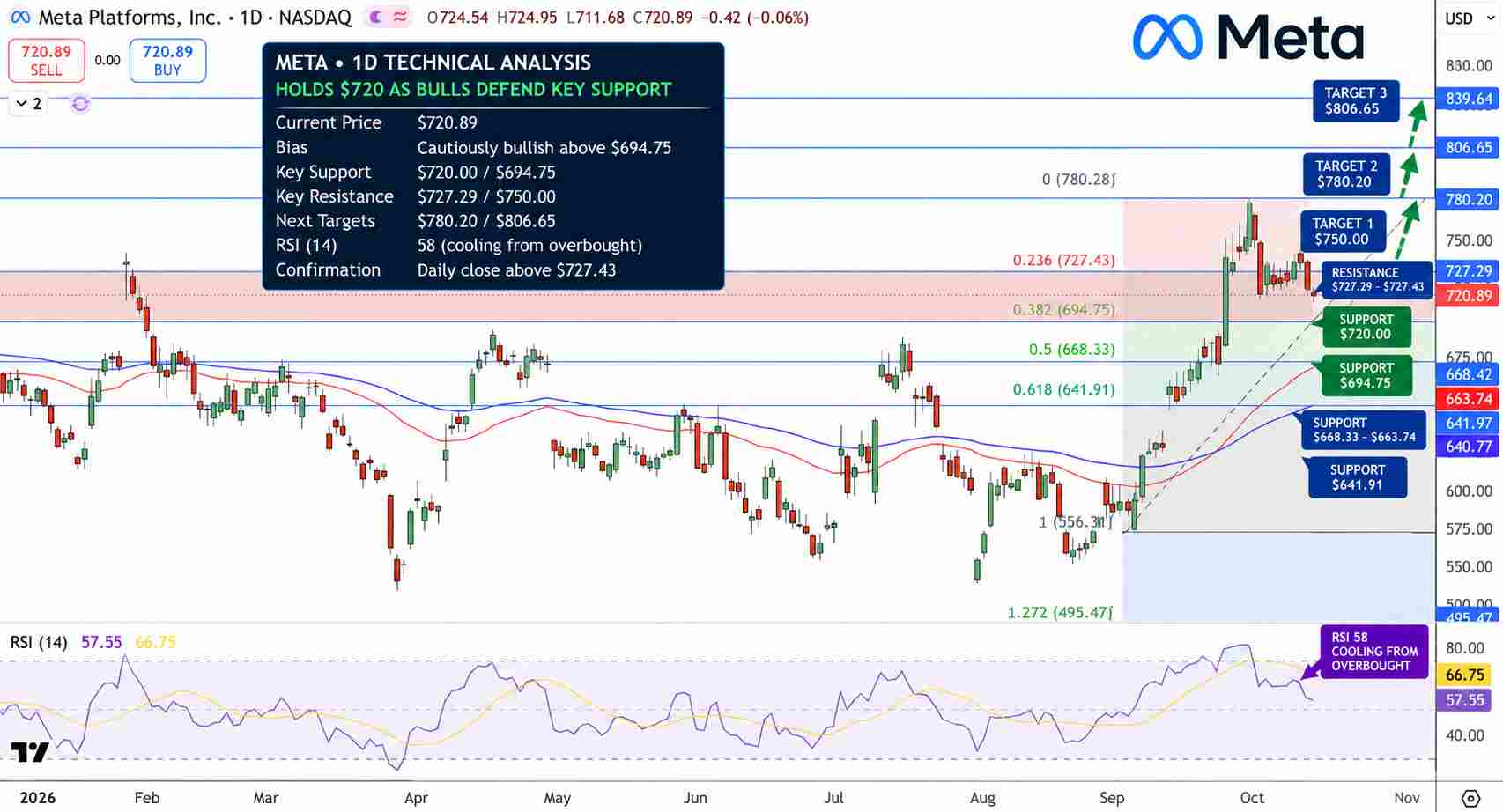
Meta Stock Price Chart - Source: Tradingview
RSI is at 58 and remains above 50, signaling no serious negative momentum.
The 38.2% Fibonacci retracement level comes in at $694.75 and would be the next support level. A close below this level would negate the overall bullish picture and send the stock to $668.33 and $663.74. Further downside potential could take the stock to $641.91.
The $727.29 to $727.43 area is the first resistance level and is followed by $750, then $780.20 to $780.28. A move above this area exposes the next level of resistance at $806.65.
The overall bullish picture remains, as long as the stock holds above $694.75. A consolidation of the pattern is likely, given RSI is around 58.
Key Levels
• Latest close: $720.89
• Major Support: $720, $694.75, $668.33 to $663.74
• Major Resistance: $727.29 to $727.43, $750, $780.20
• RSI: 58
• Recovery trigger: sustained daily close above $727.43
• Breakdown trigger: sustained daily close below $694.75
Why is Meta stock in focus now?
Meta is in the spotlight because Muse has begun to create a consumer AI platform that could become meaningful, while the core advertising business has grown by 27%. Against that backdrop, investors are evaluating opportunities, especially considering Meta's $130 billion to $145 billion capital spending program, weak free cash flow, and billions of dollars in losses from Reality Labs.
What level confirms a stronger META recovery?
A daily close above $727.43 would continue to improve the short-term trend, and increase the likelihood of a rally to $750 and then $780.20. A close below $694.75 would weaken the recovery, and put $668.33 in play.
Bottom Line
October begins with a lot of positivity around the core Meta business. The core advertising business is growing by over 25% and daily user engagement is rising. AI is becoming very much a part of everyday life with the launch of Muse. In addition, Meta has the distribution advantage that makes Muse much more commercially relevant than your standalone AI app.
Constructively, META remains bullish above $694.75, but the next phase of the program is likely going to be centered around AI and Custom Silicon to drive incremental revenues and justify the $130-145 billion capital program.
Find out more