Shares of storage solutions provider Sandisk retreated this week, as broader weakness in technology stocks weighed on the sector. The stock fell about 7% on Monday to $541.64, extending a pullback over the past five sessions.
Storage-related stocks have come under pressure amid a rotation toward defensive assets and rate-sensitive sectors. Weakness in large-cap technology names, including Intel, has weighed on high-beta semiconductor and storage stocks, prompting profit-taking after recent gains.
Industry Outlook Remains Supportive
Longer term, industry fundamentals remain constructive. Goldman Sachs said in a recent note that AI-driven compute expansion could result in one of the most severe supply shortages on record for DRAM, NAND and high-bandwidth memory (HBM) in 2026–2027. The bank said strong server demand could offset weaker consumer electronics sales, supporting tighter supply conditions and potential price recovery for memory producers.
Sandisk’s earnings beat and positive guidance provide a measure of fundamental support, though analysts note that valuation remains elevated. The stock trades at roughly 9 times trailing sales and about 8 times book value, leaving it sensitive to shifts in risk appetite, interest rates and AI-related capital spending expectations.
Options Strategy Analysis
Sandisk’s options market is pricing in heightened volatility, with implied volatility near 95%, indicating elevated demand for downside and upside protection.
In such an environment, options traders may favor spread strategies to manage risk and premium costs. Bullish investors positioning for a rebound may consider bull put spreads, which benefit from stable or modestly higher prices while limiting downside exposure. More cautious traders anticipating consolidation or further pullbacks may look to bear call spreads, which generate income if the stock fails to rally meaningfully.
I. Bullish Strategy: Positioning for a Rebound on Industry Cycle and Fundamentals
Strategy 1: Bull Put Spread
Structure:
Sell one February 20, 2026 put option with a $540 strike, and buy one put option with the same expiration and a $530 strike.
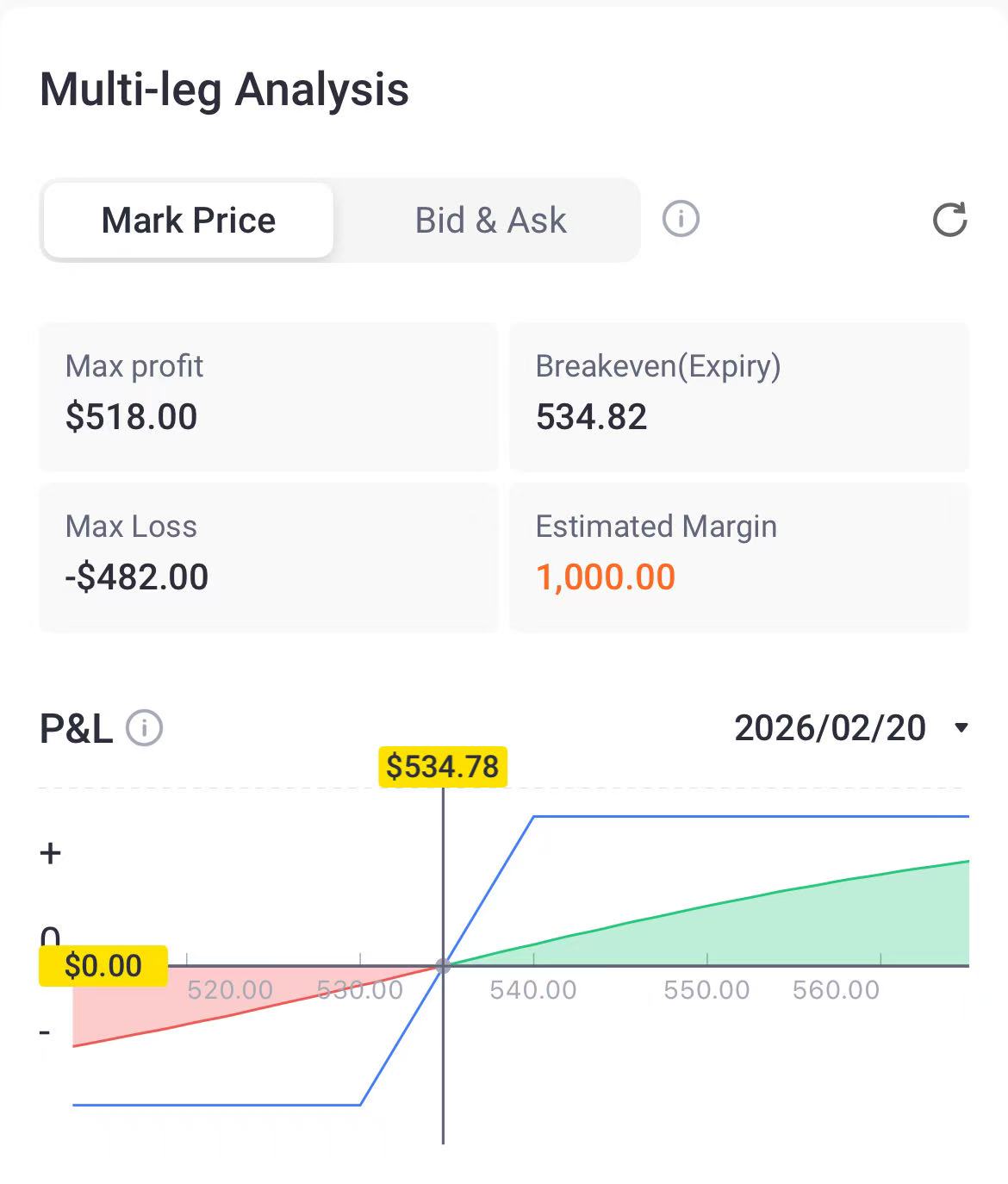
$SNDK Vertical 260220 530.0P/540.0P$
Net credit: approximately $5.18 per share (based on the prior trading day’s close; actual fills may vary)
Maximum profit: $518 per spread (if the stock is ≥ $540 at expiration)
Maximum loss: $482 per spread (if the stock is ≤ $530 at expiration)
Breakeven: $534.82
Estimated margin requirement: $1,000
Rationale:
In a high-IV environment, this strategy benefits from selling out-of-the-money puts to collect premium, while buying a lower-strike put to cap downside risk. The position can generate profits if the stock rises modestly or trades sideways. The breakeven level of $534.82 provides a meaningful margin of safety relative to the current price.
Investors with a higher risk tolerance or a stronger bullish view may choose to sell a higher-strike put to increase premium income, while more conservative investors can narrow the spread to reduce maximum loss.
II. Bearish Strategy: Hedging Against Short-Term Technical Pullbacks and Valuation Pressure
Strategy 2: Bear Call Spread
Structure:
Sell one February 20, 2026 call option with a $550 strike, and buy one call option with the same expiration and a $555 strike.
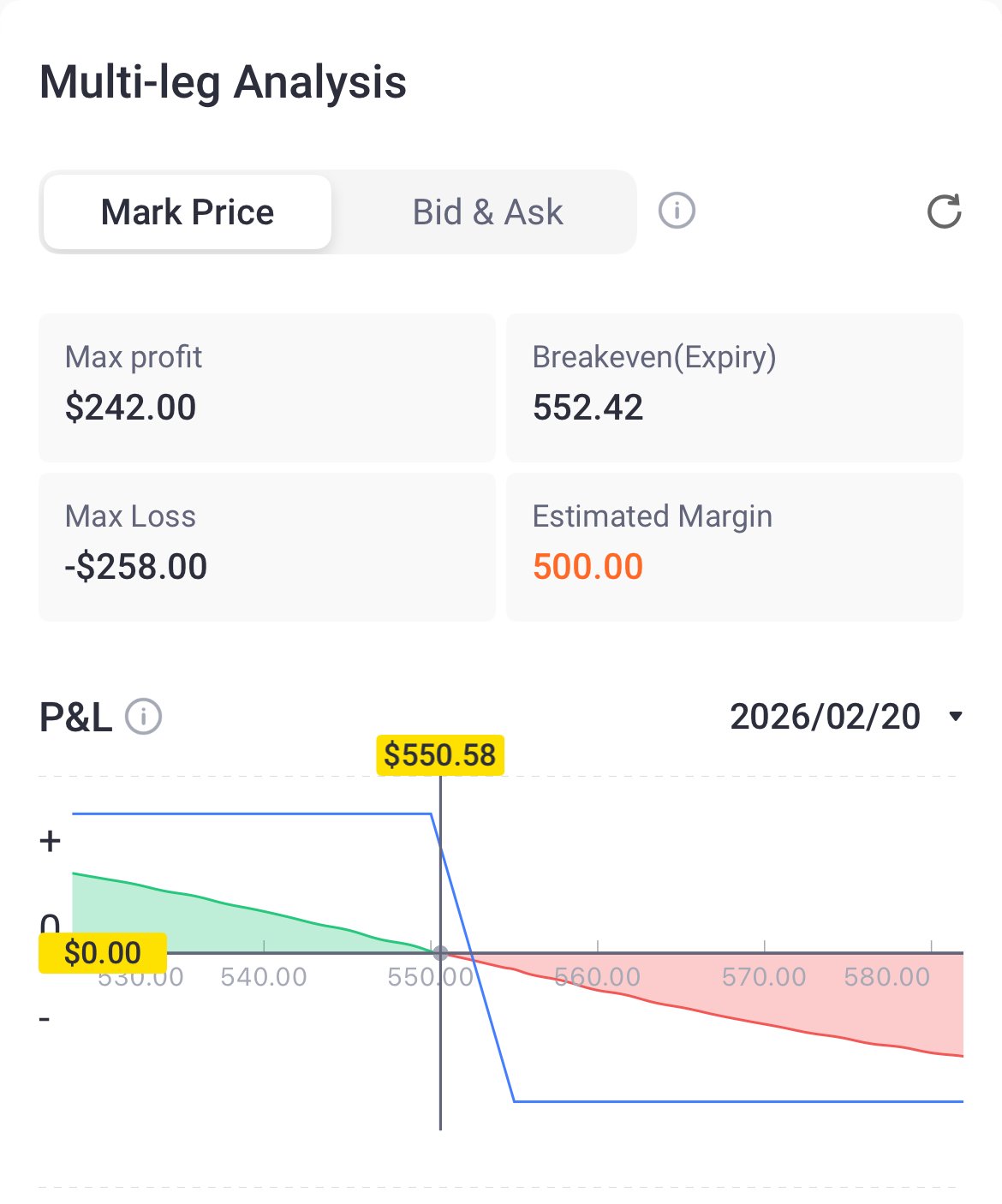
$SNDK Vertical 260220 550.0C/555.0C$
Net credit: approximately $2.42 per share (based on the prior trading day’s close; actual fills may vary)
Maximum profit: $242 per spread (if the stock is ≤ $550 at expiration)
Maximum loss: $258 per spread (if the stock is ≥ $555 at expiration)
Breakeven: $552.42
Estimated margin requirement: $500
Rationale:
This strategy is suitable for scenarios where the stock is expected to decline or consolidate. By selling a call option to collect premium and purchasing a higher-strike call to limit upside risk, investors can profit if the stock pulls back modestly or fails to stage a meaningful rally.
More aggressive investors or those expecting further downside may opt to sell a lower-strike call to enhance premium income, while risk-averse investors can sell higher-strike calls to reduce exposure.