TradingKey - On July 20, Eastern Time, according to South Korean media outlet ZDNET Korea, the world's three major memory chip giants, Samsung Electronics, SK Hynix ( SKHY) and Micron ( MU) have recently halted all in-house development projects for CXL (Compute Express Link) controllers, shifting instead to sourcing solutions from external fabless chip design companies.
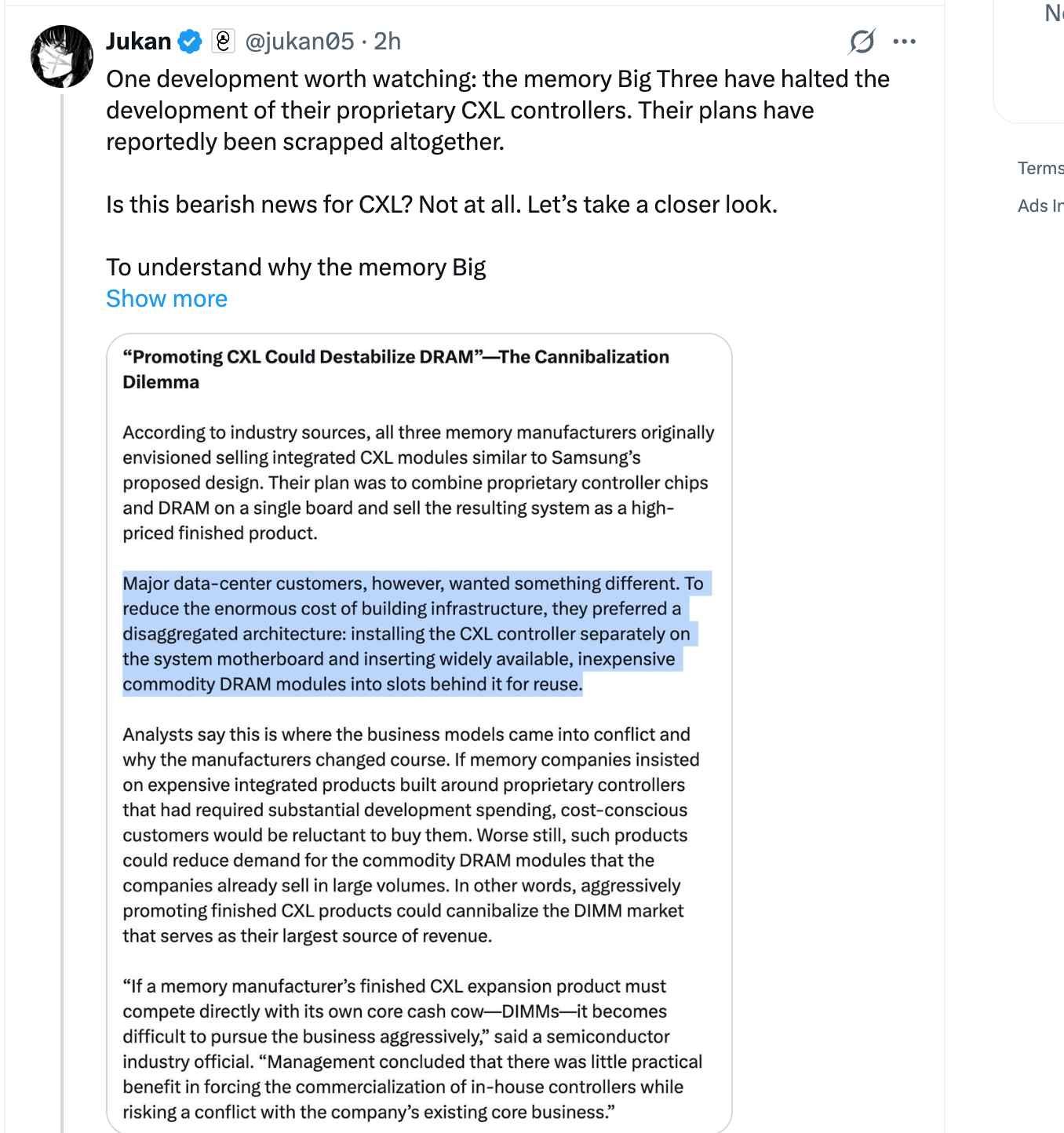
Citrini analyst jukan posted on X that all three memory manufacturers have adjusted their commercialization plans for CXL controllers. Micron was the first to shut down its in-house controller R&D, switching to PrimeMass's solution. SK Hynix notified its major partners that it would terminate internal CXL controller development, with relevant R&D personnel reassigned to PIM (processing-in-memory). Samsung Electronics opted for a compromise, deciding not to sell its self-developed controllers externally but keeping them for internal use within its R&D team, while commercial products will be supplied by external vendors. An industry insider disclosed to the media that Samsung has removed this business from its official commercialization projects, retaining it only as a cutting-edge R&D project.
[Source: X]
CXL technology addresses the long-standing "memory wall" bottleneck in AI servers by increasing memory bandwidth and capacity. Memory manufacturers once viewed it as a breakthrough to unlock high-margin markets—so why this collective retreat now?
The problem lies in the business model. The lifeblood of Samsung, SK Hynix, and Micron is DRAM chip shipment volume; they initially wanted to bundle their self-developed CXL controllers with DRAM into high-priced integrated modules for sale. However, hyperscale cloud providers like Amazon AWS and Microsoft Azure have little interest in such proprietary solutions. Once a modular solution is locked in, they cannot flexibly switch between different brands of DRAM, which also squeezes their bargaining power.
Forcefully promoting CXL modules with self-developed controllers would be tantamount to using new products to cannibalize their own DIMM memory module business. Furthermore, the more modules sold, the fewer DRAM chips are actually consumed, directly squeezing shipment volumes. Weighing the options, defending the core business of chip shipments is more cost-effective than pushing an integrated solution.
For fabless chip design companies, the exit of Samsung, SK Hynix, and Micron leaves a critical gap. Analysts believe that Marvell ( MRVL ), Montage Technology, Astera Labs, and PrimeMass will be the primary beneficiaries. Both Astera Labs and Marvell have mature CXL controller product lines, and the shift by the three memory giants toward external sourcing directly benefits these suppliers.
What the three memory giants are giving up is the commercialization of self-developed controllers, not the CXL market itself. They will continue to sell memory modules based on the CXL interface, except the controllers will be sourced externally rather than developed in-house. AI servers' demand for memory pooling and data flow continues to rise; whether CXL technology can gain traction does not depend on whether the giants develop it themselves, but on whether the entire supply chain can foster more efficient collaboration.
Find out more