Delta Air Lines (NYSE: DAL) enters October with passenger demand and pricing trends still looking good, but with another energy price increase placing fuel back in the spotlight for earnings. DAL closed October 1 at $84.13, up 0.80% for the day, with an intraday high of $84.23 and a low of $82.55. The stock is currently below the July 2, 52 week high of $95.68, meaning the October 9 earnings release will likely be the next big catalyst showing if good revenue can make up for rising costs.
What stands out to me is that Delta's revenue quality is still strong. Premium travel, corporate travel and Delta's frequent flyer base are some of the better growing revenue streams within the airline. Along with that, the balance sheet is looking better. The key here is if that revenue mix can hold up if costs remain elevated, and higher unit costs don't return to pre-covid levels.
October 9 Earnings Are the Next Major Catalyst
Delta Air Lines will report September quarter 2026 earnings on Friday, October 9. We expect management will discuss revenue, margins, bookings, costs and offer an update on the full-year outlook. The report will be the first since management issued an investment community update in July. At that time, management noted that September quarter revenue was tracking “well” and the airline operated with a lower fuel price assumption compared to current market conditions.
For the current September quarter, management issued guidance for mid-teens year-over-year revenue growth, adjusted operating margin of 11% to 13% and adjusted EPS of $2.00 to $2.50. The company also held full-year guidance for adjusted EPS of $6.50 to $7.50, free cash flow of $3 billion to $4 billion and gross leverage of approximately 2 times. The main focus will be if the company held on to these goals after the recent volatile fuel markets.
Premium Travel Remains Delta’s Biggest Advantage
Delta’s June quarter results show why premium travel is a key strategic differentiator. Total premium revenue increased 17% year-over-year, with premium and diversified revenue streams collectively representing 61% of adjusted revenue (up from 59% last year). Additionally, all corporate segments reported double-digit growth, with premium corporate sales growing over 25%.
With a premium-focused travel mix, Delta derisks its earnings stream and benefits from more stable and predictable revenue, particularly when compared to airlines with a higher exposure to basic economy fares. Higher premium travel yields help offset reduced leisure travel, as does corporate travel. As of now, I see strength in premium and corporate travel as the most likely way Delta can cover the increase in pressure on its bottom line in the near to medium term.
Main Cabin Revenue Also Improved
Improved main-cabin economics was part of Delta's improvements in the second quarter. Unit revenue in the main cabin rose by double digits for the second consecutive quarter. Domestic unit revenue improved by 12%, and international unit revenue improved by 8%. This shows the improvement wasn't just in the hands of the higher end travelers.
As the premium traveler returns, the focus can return to improving the group in the center and the back of the plane, which creates better flexibility for Delta to ease cost inflation concerns. If the focus of the recovery stays on the premium traveler, then the focus on business travel demand also stays, and Delta would be more vulnerable to premium traveler demand.
American Express and SkyMiles Add a High-Margin Engine
Another major source of resilience for Delta is the loyalty ecosystem. Loyalty revenue and related increased 19% year over year in Q2, and American Express remuneration increased 16% to $2.4 billion. Delta reported strong card acquisition and card spending, which reported double digit growth for the seventh consecutive quarter.
The relationship with American Express is positive for Delta, because loyalty economics are less correlated to aircraft and capacity, compared to ticket revenue. Rising costs for fuel and maintenance eat into Delta’s margins, and loyalty economics give Delta a stable revenue stream to make up for the EPS dilution. It is expected that cardholder spending and engagement was strong for the September quarter.
Fuel Is the Biggest Near-Term Earnings Risk
Fuel is the biggest near-term risk for Delta. Delta’s adjusted fuel costs for Q2 were $4.41 billion, an increase of 77% year over year. Delta’s average fuel cost for Q2 was $3.93, an increase of 75% from the prior year. Adjusted revenue for Q2 grew by 14%, but EPS decreased from $2.12 to $1.56 due to a large fuel headwind.
For Delta’s Q3 guidance, the company assumed an average fuel price of approximately $3.15 per gallon for the quarter, a 5 cent refinery benefit, and a forward curve for July. Volatility in energy markets has made it difficult to predict fuel costs, with Brent crude prices above $100/barrel in October. This means management’s assumptions around Q4 fuel costs and the fuel expenses realized by Delta for Q4 may be just as important to evaluate for investors.
Non-Fuel Costs Still Need Improvement
Delta’s adjusted non-fuel unit cost increased 6.8% year over year in Q2 and was well above management’s target of low-single digit increases. The company noted that it expects modest improvement in Q3 and better progress in Q4 as capacity growth normalizes. This puts the October report in a difficult situation as investors will need to see both fuel and non-fuel costs be on a better trajectory.
If management is successfully mitigating non-fuel costs, productivity and utilization are offsetting higher wage, maintenance and other costs. A quarter with a combination of soaring revenue and a huge increase in non-fuel CASM would likely still be good news to the Street as it would indicate that a large increase in fares is partly offsetting non-fuel cost pressure and margins are still being protected.
Balance Sheet Improvement Adds Support
Delta finished Q2 with adjusted net debt of $13.59 billion, which was $2.73 billion lower than a year earlier. Quarter-end liquidity was $7.7 billion with $3.1 billion undrawn revolving credit. Delta also has targeted gross leverage of approximately 2 times by year-end.
A stronger balance sheet gives Delta the flexibility to adjust capacity to changes in fuel prices and demand. Repeated debt reduction alongside positive free cash flow would further strengthen the quality of Delta’s earnings.
Dividend Growth Signals Confidence
Delta declared a quarterly dividend of $0.215 per share on September 24, to be paid on November 5 to shareholders as of the close of business on October 15. The payment reflects the 15% dividend increase announced earlier in the year. At the close of October 1, the annualized payout of $0.86 would yield approximately 1.0% based on the October 1 close of the stock.
At this time the yield is modest; however, the dividend is not the main reason for owning the stock. The dividend is more symbolic to show the confidence management has in returning cash to shareholders, while still being able to reduce debt. The stronger long term case for Delta is being able to increase dividends and/or share buy backs to shareholders without slowing management's confidence in the debt and the fleet.
Delta Air Lines Technical Analysis: DAL Tests Descending Trendline Near $84.47
After recovering from September support around $76.91, Delta Air Lines closed most recently at $84.13. While doing this, the price of the stock started to test an important descending resistance near the higher highs that were created around August. The stock is now testing the upper boundary of the resistance area which is near $84.47. A break above $84.47 will be a bullish signal for DAL.
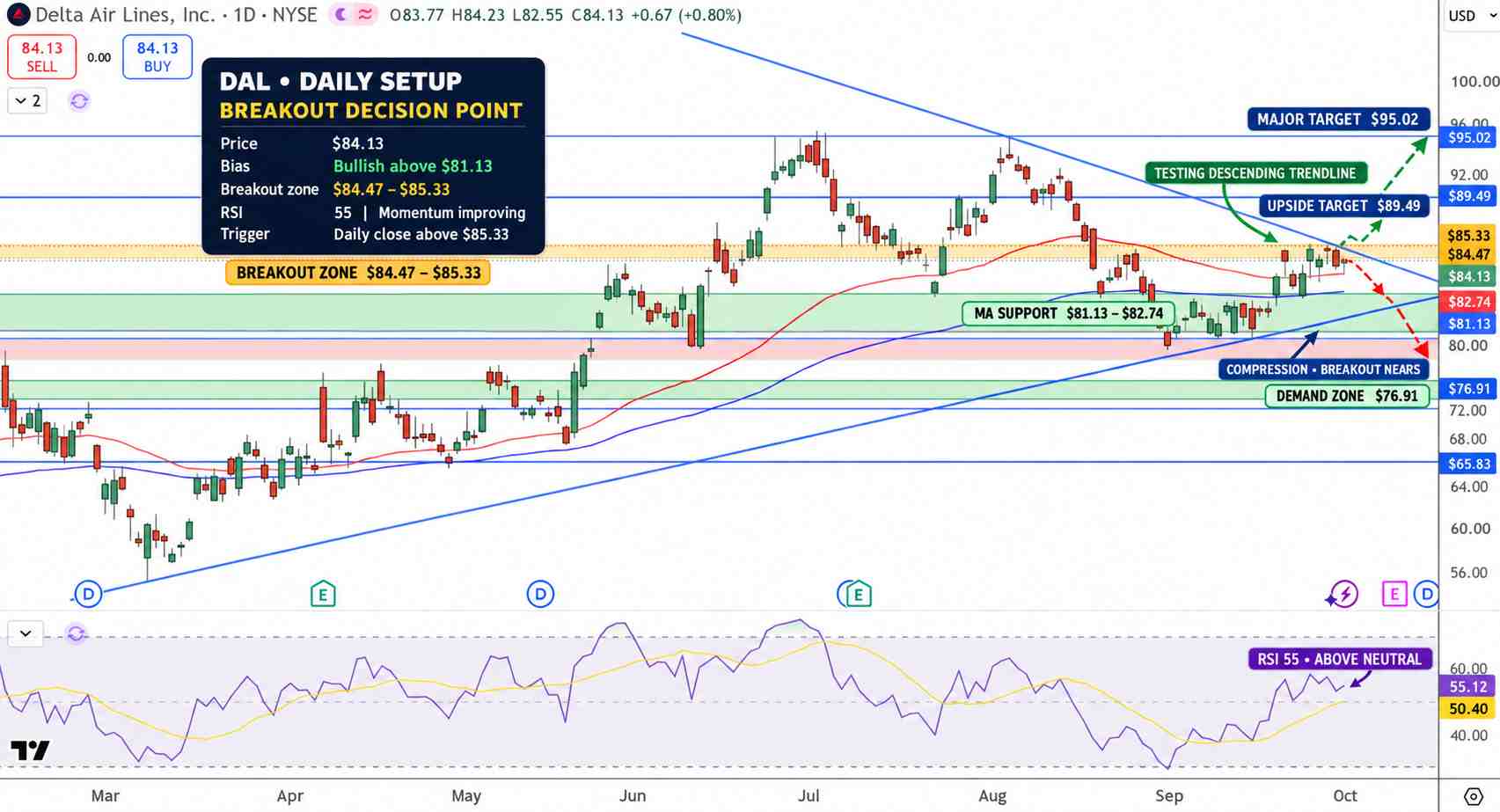
Delta Air Lines Stock Price Chart - Source: Tradingview
Also, the Relative Strength Index (RSI) is near 55 and is above its signal line near 50. A daily close above $84.47 will give a more bullish signal for DAL.
If DAL breaks out above the first important resistance near $84.47 to $85.33, the next important resistance will be created near $89.49. $85.33 will be a very important support if the breakout above $84.47 is confirmed. A break above $89.49 would expose the next important resistance near $95.02.
If DAL breaks support near $81.13 and $82.74, it will shift attention back to the rising trendline support and the September low near $76.91.
The rising trendline and support near $81.13 will keep DAL bullish, but breakout above $84.47 to $85.33 is very important to confirm the bullish signal.
Why is Delta Air Lines stock in focus now?
DAL is in focus because it just reported solid Q2, including double-digit revenue growth and renewed customer loyalty. Investors will be watching whether customer loyalty and demand are strong enough to offset higher fuel costs. If DAL’s management is successful in maintaining the $6.50 to $7.50 EPS guidance, it would mean continuing strong loyalty and travel demand.
What level confirms a stronger DAL breakout?
A daily close above $85.33 would signal an even stronger breakout to $89.49, and would also signal that the descending trendline has been broken. A close below $81.13 would weaken the breakout setup and $76.91 would come back into focus.
Bottom Line
Delta is entering Q3 with some of the best revenue potential in the airline industry. For the second quarter, travel demand was strong from both the premium and main cabin travelers. The focus has also been on traveler loyalty. Travel demand and the company’s revenues have aided Delta in improving their balance sheet. The main risk for airlines is cost inflation, especially with fuel costs. The assumption for fuel costs in the third quarter was around $3.15 a gallon and now looks too low relative to current fuel prices. Delta and the other airlines will have to raise their prices to account for the higher fuel costs to keep profits up.
From a technical perspective, DAL is testing a breakout zone around $84.47 to $85.33. A breakout from that area would signal a move to $89.49. A loss of $81.13 would signal that a breakout is not happening. With Delta’s third quarter earnings report coming up, the focus is on if Delta and other airlines can keep ticket prices high to increase profits even with higher costs.
Find out more