TradingKey - On October 12, South Korean stocks fell sharply, with the Korea Composite Stock Price Index (KOSPI) closing down 3.65% at 6,384.25 points, breaching the 6,400-point mark. Japanese stock markets were closed today for a public holiday.
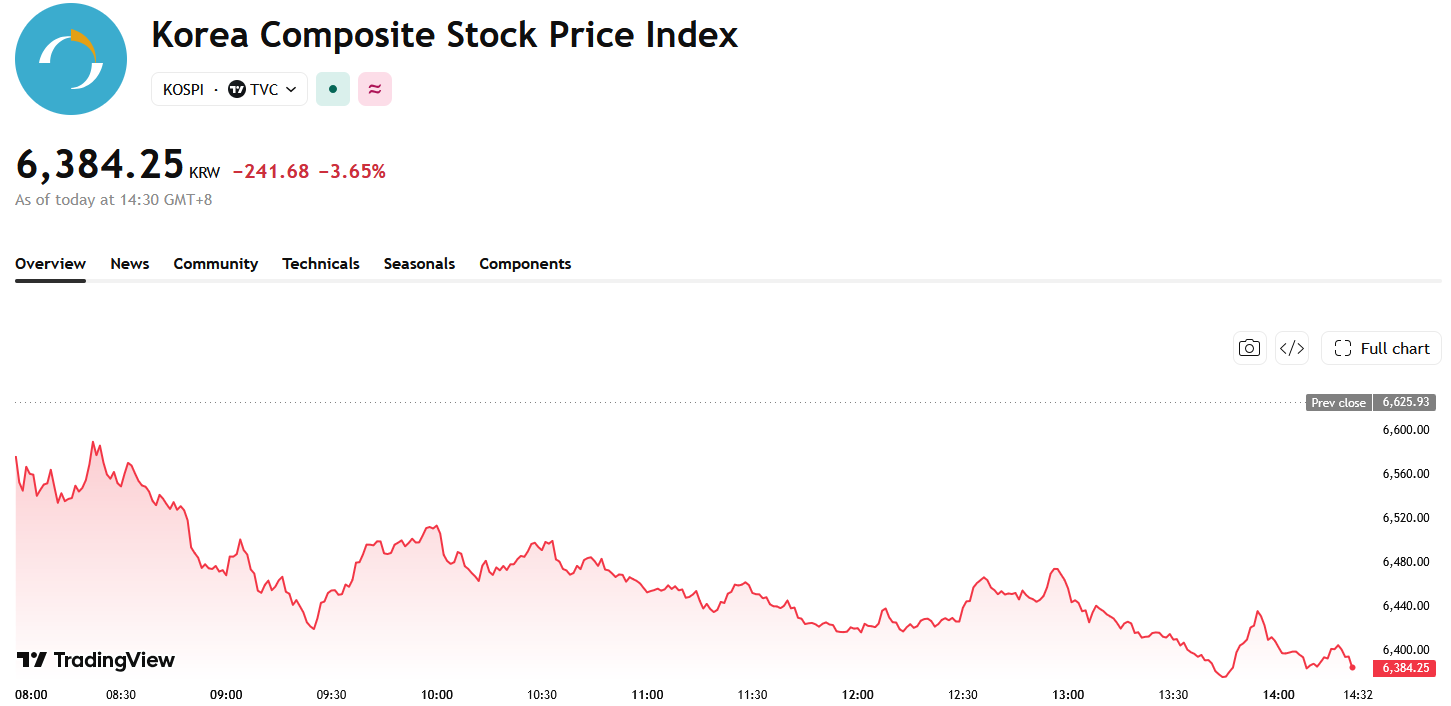
Source: TradingView
South Korean semiconductor leaders faced noticeable sell-offs. Samsung Electronics closed down 4.39% at 250,500 won (about $188); SK Hynix fell 4.52% to 1.605 million won. As major heavyweights in the South Korean stock market, the two memory chipmakers weakened in tandem, further exacerbating downward pressure on the market.
Market data shows that South Korean stock market turnover has declined by about 70% from its peak in late May. Foreign investors have accelerated capital outflows, while domestic retail investors are also gradually scaling back their stock investments. Previously, Samsung Electronics and SK Hynix benefited from the boom in AI infrastructure investment, becoming key targets for investors seeking exposure to the artificial intelligence supply chain. However, as the market begins to reassess the growth prospects of the memory chip industry, the South Korean stock market's heavy reliance on a few semiconductor leaders has gradually become a risk.
In the face of sharp stock market volatility, South Korean government and central bank officials issued a flurry of statements on October 12. South Korea's Finance Minister stated that against the backdrop of elevated global bond yields, the government will take market stabilization measures when necessary to cope with financial market fluctuations.
Bank of Korea Governor Shin Hyun-song responded to issues regarding risk warnings for single-stock leveraged ETFs, stating that the central bank had previously failed to adequately caution the public about the risks of such products and apologizing to the nation. Shin admitted that in late May, he did not fully grasp the volatility in the South Korean stock market and the memory chip sector.
Shin also admitted that the Bank of Korea's judgment in its June Financial Stability Report—which suggested that single-stock leveraged ETFs could help prevent domestic capital flight and attract more overseas capital inflows—was inappropriate. As market volatility intensifies, the potential risks associated with leveraged investment products are drawing increased scrutiny.
Find out more