


Exchange rates. We all know what they are, and in most cases, we’ve all been stung by them. Like that time you decided to go on a holiday and kept holding out for a better exchange rate — and then suddenly the rate dropped, and your spending money went from $1500 to $1200 in the blink of an eye. You probably kicked yourself for not exchanging it sooner.
Understanding exchange rates
In simple terms, an exchange rate is the value of one currency compared to another. It moves constantly, driven by multiple factors — inflation, interest rates, and a country’s trade balance.
These factors cause currencies to rise and fall, and when you trade or convert between them, FX fees start to matter. Even small changes or hidden charges can make a difference in the final value of your investment.
What are FX fees and why they matter in investing
An FX fee (foreign exchange fee/ forex fee) is the cost charged when you convert one currency into another — for example, changing AUD to USD to buy US stocks. It’s a standard cost in international trading and applies whenever a transaction involves different currencies.
How FX fees are charged
FX Fees can appear in two ways:
Explicit Fees: A clearly stated percentage or flat fee charged by your broker or bank when converting currencies. For example, a platform may charge 0.4% per conversion.
Implicit Fees (Spread): A hidden cost built into the exchange rate you’re offered. The platform or bank quotes a slightly worse rate than the real market rate — that difference is their profit margin.
Together, these two make up your real forex fee, even if only part of it is visible on paper.
Where you encounter FX fees in investing
FX fees show up in more places than many investors realise:
Stock trading: When you buy or sell foreign-listed shares in a different currency.
Global ETFs or Mutual Funds: When the fund itself deals in another currency.
Dividend repatriation: When overseas earnings or dividends are converted back to your base currency.
Account transfers: When moving funds between multi-currency accounts or platforms.
Each of these transactions may trigger a small forex charge, which can quietly eat into profits.
How FX fees affect your returns
Every time you convert currencies, you pay a fee. For instance, if you exchange AUD 10,000 to USD with a 0.5% FX fee, you instantly lose AUD 50 — before even placing a single trade.
For long-term investors, occasional conversions might not seem significant. But for active traders who frequently switch between markets, FX fees can compound quickly and cut into potential gains.
In some cases, forex charges also apply during dividend payments or fund repatriation, further reducing your actual returns. Choosing a transparent, low-fee platform helps minimise these impacts and protect your profits.
How Tiger Trade helps you save on FX fees
When it comes to investing, Tiger Trade puts you in control of your exchange rate needs. We allow you to trade AUD, USD, and HKD anytime you want — whether at the moment of placing your trade or beforehand.
Tiger Trade’s FX fee per transaction on AUD ⇆ USD is relatively low, at just 55 PIPS (basis points), and it’s already included in the exchange rate quoted to you. This transparent approach ensures minimal impact on your foreign exchange value, giving you greater confidence when trading across markets.
Competitive pricing with premium value
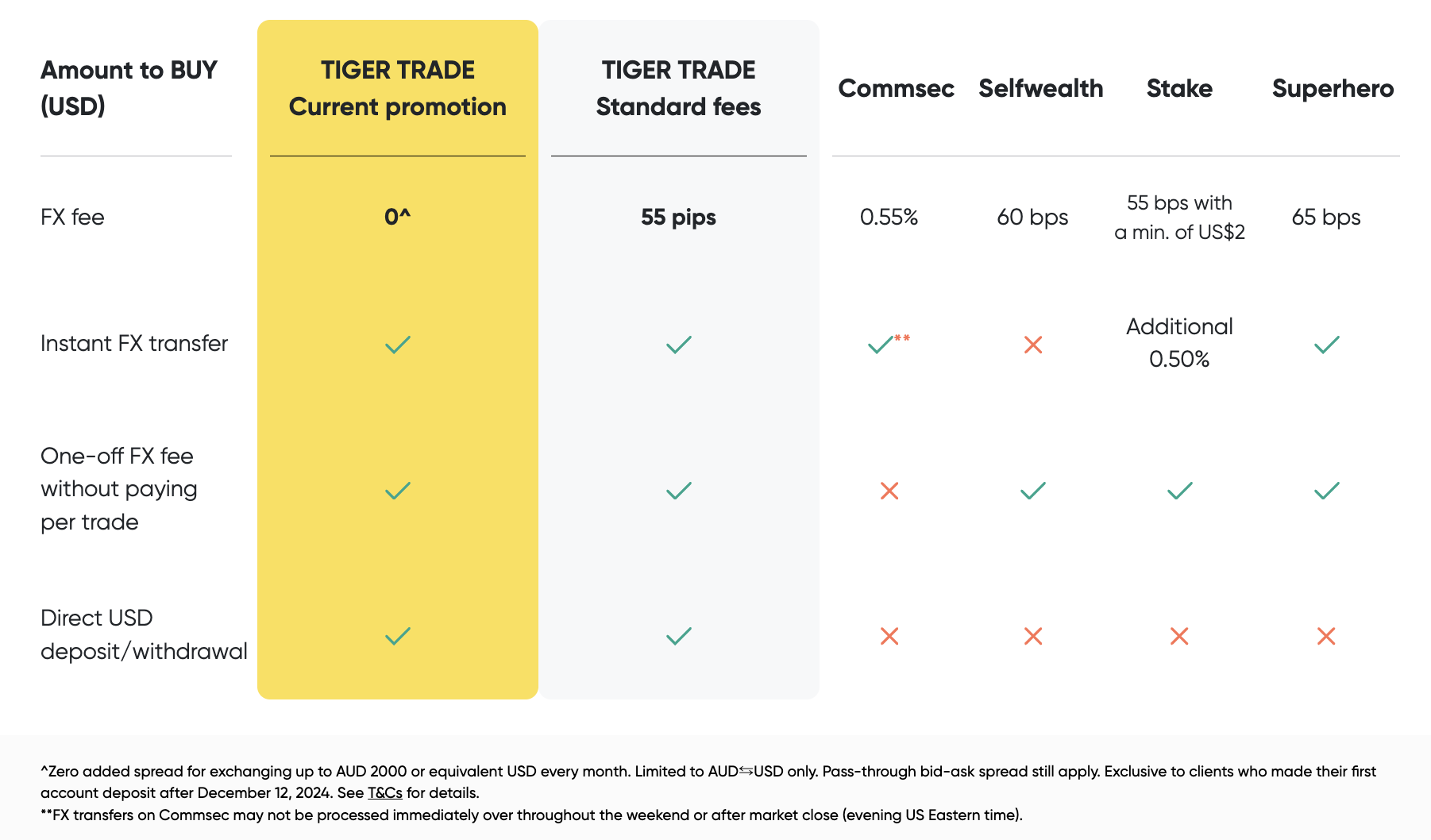
Ready to start your investment journey with Tiger Trade? Join today and gain access to the ASX, US and Hong Kong stock markets. New clients receive four $0 brokerage monthly trades on either ASX, US stock, ETFs or US options when you open an account and complete your first deposit^. Plus get zero FX fees for exchanging up to AUD 2,000** every month.
^New clients & unfunded existing clients only. Only min. brokerage waived for 4 ASX, US stocks or ETFs or options trades. Third-party fees and other fees still apply.
**0 added spread and for AUD⇆USD only. Pass-through bid-ask spread still apply.
See T&Cs for details.

