


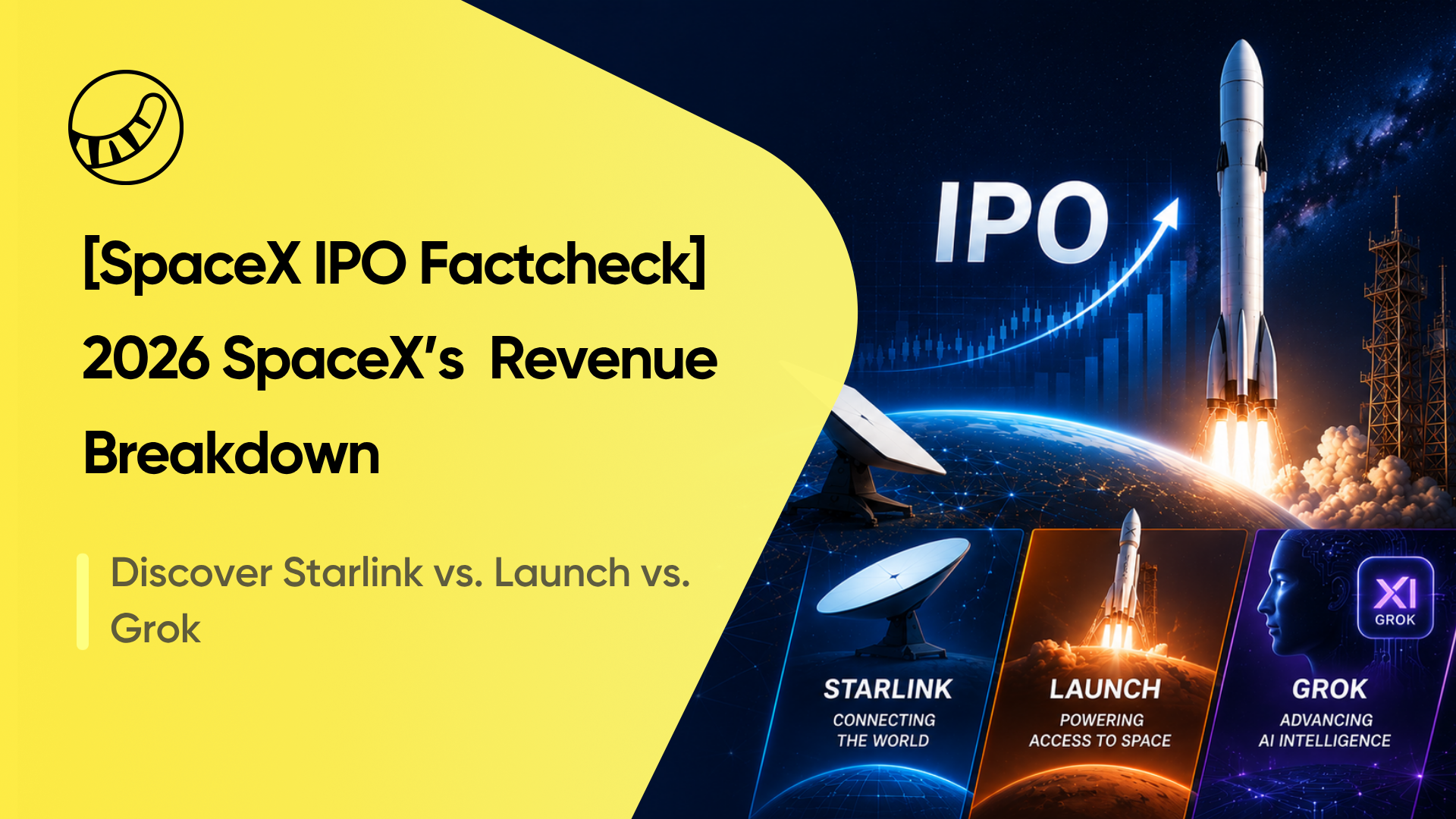
Key Takeaways:
The Profit Engine: Starlink converts 85% of its $20 billion revenue forecast into recurring subscription cash flow, acting as the primary financial driver for the company.
The Launch Ceiling: Commercial launch revenue is capping near $5 billion, as internal Starlink deployment missions monopolize the Falcon 9 flight schedule.
The AI Cash Burn: The xAI (Grok) merger introduces a heavy $14 billion cash burn rate, forcing Starlink profits to subsidize massive orbital AI infrastructure costs.
The SaaS Multiple: A $1.75 trillion valuation represents an aggressive 73x Price-to-Sales (P/S) multiple, far exceeding the multiples of established tech monopolies.
The Lock-Up Risk: Secondary market investors must monitor the 180-day lock-up expiration, which could introduce significant volatility as early insiders exit.
The upcoming SpaceX IPO requires a rigorous financial dissection to separate aerospace sentiment from hard corporate data. As the market attempts to value the entity at $1.75 trillion, examining the internal revenue architecture reveals that the company operates less like an industrial manufacturer and more like a hybrid software utility.
【Stay updated with SpaceX IPO with Tiger Trade.】
Starlink vs. Launch Services: Which Segment Is Actually Making Money?
Starlink is the definitive profit center for the organization. While the launch division builds the physical infrastructure, the satellite internet segment generates high-margin, recurring software-style revenue that sustains the broader corporate ecosystem.
The Subscription Moat
Starlink commands a formidable 63% EBITDA margin because it operates on a subscription-based utility model.
Growing from 9.2 million users in 2025 to a projected 16.8+ million by the end of 2026, the segment’s $20 billion revenue stream is 85% recurring. This predictable, high-margin cash flow provides SpaceX with a "SaaS-like" financial profile, insulating it from the cyclical nature of traditional aerospace contracting.
Why Commercial Rocket Launch Growth is Slowing Down
While the Falcon 9 program continues to break flight frequency records, external commercial launch revenue is bottlenecked.
The underlying reason is capacity allocation: the vast majority of the 2026 launch manifest consists of internal missions required to deploy additional Starlink satellites. By prioritizing its own constellation, SpaceX sacrifices immediate third-party launch revenue to build its long-term subscription moat.
2026 Revenue Forecast Comparison Table
Business Segment | 2026 Revenue Est. | Growth Profile | Free Cash Flow Status |
Starlink (Internet) | $15-$20.0 Billion | High-Growth Recurring | Highly Positive |
Launch (Falcon/Starship) | $5.0 Billion | Capacity-Constrained | Moderately Positive |
Government / Starshield | $3.2 Billion | Stable/Contracted | Positive |
*Source: SpaceX Profitability Trends 2026
Is the Launch Business Still the Core Driver for SpaceX Investors?
Launch operations provide the underlying technology moat, but they are no longer the primary revenue driver. They function essentially as an internal service layer to enable Starlink’s broader product layer.
Efficiency as a Moat: The Falcon 9 is expected to exceed 150 launches in 2026. Because the booster stages are reusable, SpaceX’s operational costs are 50% to 70% lower than legacy competitors like Blue Origin or Arianespace, establishing a durable pricing advantage.
The Revenue Cap: Despite total market dominance in payload delivery, launch revenue is capped by hard physical constraints, specifically turnaround times and pad availability. Consequently, it is projected to contribute roughly $5 billion in 2026.
The Starshield Factor: Government and military contracts, operating through the Starshield initiative and NASA partnerships, contribute a steady 10% to 15% of revenue. This dedicated $3.2 billion to $7 billion pipeline provides a reliable "sovereign floor" to the company's valuation.
Is the Grok Merger a Revenue Driver or A Cash Burner?
Currently, the integration of xAI (Grok) operates as a massive cash burner. The merger successfully inflated the company's valuation narrative, but it relies entirely on Starlink's operating income to fund severe capital expenditures.
The "Orbital AI" Narrative vs. Financial Reality
The February 2026 merger fundamentally altered the IPO trajectory. By proposing "Compute-in-Orbit", the concept of placing AI data centers in space to bypass Earth’s energy grid constraints, the narrative shifted.
This futuristic infrastructure play successfully pushed the target IPO valuation from $800 billion to $1.75 trillion, framing the company as an integrated artificial intelligence utility.
Subsidizing the AI War
Fact-checking the bottom line reveals a steep cost for this AI integration. While Grok and the X platform generate approximately $3.2 billion in revenue, the associated AI infrastructure requires a staggering $14 billion burn rate.
These massive capital expenditures pull the consolidated free cash flow into negative territory, meaning the Spacex profit generated by Starlink is actively subsidizing the xAI development war.
Does a $23.8 Billion Revenue Forecast Justify a SpaceX $1.75 Trillion Valuation?
A 73x forward Price-to-Sales multiple requires investors to price the company as a flawless SaaS monopoly. This premium significantly outpaces established tech giants and carries structural secondary market risks.
Breakdown the 73x P/S Ratio
Comparing SpaceX's aggressive 73x P/S ratio to other tech infrastructure giants highlights the valuation premium. For context, Meta trades at approximately 16x sales, and Alphabet sits near 25x.
A 73x multiple implies that the market accepts the 50%+ overall profit margin and the absolute industry monopoly as durable enough to warrant a valuation disconnected from current revenue realities.
The Lock-Up Trap: What Happens When Insiders Sell?
Retail investors must be highly cautious regarding the 180-day lock-up expiration period post-IPO. Thousands of early employees and venture capital firms hold shares at a fraction of the listing cost. When this lock-up period expires, a sudden influx of insider selling could flood the market, causing significant downside volatility.
FAQ
1. Is SpaceX actually profitable?
A: Yes. SpaceX hit "break-even" cash flow in late 2025. Projections for 2026 show an EBITDA margin of 63%, driven almost entirely by Starlink.
2. Why is the P/S ratio so much higher than Boeing?
A: Because Boeing is a manufacturer. SpaceX is 75% a subscription internet provider. You are paying for the SaaS margins, not the aluminum.
3. Does xAI/Grok have its own revenue?
A: Currently, Grok revenue is bundled via X (Twitter) and private subscriptions. Post-merger, it will likely be integrated as a "Premium Intelligence" tier for Starlink enterprise users.
Ready for SpaceX IPO?
When exploring how to invest in SpaceX, investors often search for the "best pre IPO investment platform" to gain early access.
For retail investors operating through a Hong Kong broker, maneuvering through the secondary market requires an advanced online trading platform and disciplined capital management.
Tiger Trade is here! Explore Tiger Brokers Welcome Rewards and Account Funding Benefits Here
Disclaimer: The information provided is for educational purposes only and does not constitute financial advice. Market conditions change rapidly, and individual financial situations vary. Past performance is not indicative of future results. Investment involves risk. Investors should read the relevant offering documents and consult with their own advisors before making investment decisions.
Reference
Starlink: 2025 Progress Report
SpaceX Stock: SpaceX Profitability Trends 2026
Octagon AI: How many launches will SpaceX have in 2026
Technology Org: Grok Flops in Washington, Denting SpaceX AI Story