TradingKey - Marvell Technology (MRVL) plans to acquire Lumentum (LITE), representing an enterprise value of approximately $115 billion when the transaction was announced. This acquisition will complement Marvell's laser technology and manufacturing capabilities, and could also leave Broadcom (AVGO) facing a competitor with a more complete product portfolio in AI optical communications.
TrendForce noted that, based on estimated 2026 wired communications semiconductor market revenue, Marvell and Lumentum rank fourth and eighth, respectively, and their combined share will approach 7%, trailing only Nvidia (NVDA) and Broadcom.
For Broadcom, the potential impact primarily stems from two pathways: challenges to its integrated product advantage, and pressure on order share and bargaining power as customer procurement options increase.
Marvell Bolsters Laser Capabilities to Challenge Broadcom's Integrated Optical Interconnect Solutions
Broadcom's competitive edge in AI optical communications stems from its command of both chips and optical components. Its portfolio spans Tomahawk switch chips, digital signal processors (DSPs), and laser light sources, enabling it to deliver interoperable products tailored to customers' network architectures.
Marvell's previous strengths were largely concentrated in electronic chips. With the addition of Lumentum, it gains indium phosphide lasers, optical modules, and optical switching technology, enabling it to co-design and validate chips, optical engines, and laser light sources together, reducing the burden on customers to coordinate across different vendors.
This integration is especially critical in the era of co-packaged optics (CPO) and near-packaged optics (NPO). These architectures move optical components closer to compute or switch chips to alleviate power consumption and bandwidth bottlenecks in high-speed transmission, while also heightening the importance of co-designing different components.
Counterpoint believes that lasers are at the core of this transaction. Even as optical interconnect architectures shift and some solutions reduce reliance on standalone DSPs, light sources remain indispensable. Acquiring Lumentum therefore both complements Marvell's product portfolio and helps it secure supplies of critical lasers.
For Broadcom, this means customers will have a more competitive alternative supplier when selecting complete optical interconnect solutions. Marvell will have the opportunity to expand from selling individual chips to capturing a greater share of product revenue across the entire optical link.
Broadcom Orders, Product Premiums May Face Pressure as AI Optical Communication Procurement Options Increase
TrendForce believes that the combined company could help Nvidia and cloud service providers maintain procurement flexibility and reduce their reliance on Broadcom. If Marvell can offer solutions with comparable performance, cost, and delivery capabilities, customers will have greater leeway to allocate orders and compare quotes on new projects. As a result, Broadcom's future incremental revenue could fall short of prior expectations; if price concessions are needed to retain orders, product profit margins could also be affected.
However, Broadcom already has a track record of commercialization. As early as October 2025, the company announced that shipments of its third-generation CPO switch chip, Tomahawk 6-Davisson, had begun. For Marvell to win over these customers, it still needs to catch up in product validation and scaled delivery.
Vertical integration could also create some order opportunities for Broadcom. Lumentum's Cloud Light unit operates an optical module business and competes with some customers that purchase Marvell's DSPs. Counterpoint expects these customers may strengthen multi-vendor sourcing and shift a portion of their DSP orders to vendors such as Broadcom.
The transaction is expected to close in the first half of 2028, subject to shareholder and regulatory approvals. TrendForce expects that Chinese regulatory scrutiny will focus on laser supply restrictions, product bundling, and whether priority is given to supplying its in-house module business.
Therefore, the most direct challenge this acquisition poses to Broadcom is weakening the scarcity of its comprehensive product portfolio. If Marvell secures more next-generation optical interconnect projects, Broadcom's order growth and pricing power will face a substantive test, which could also prompt the market to reassess the growth expectations and valuation premium for its AI business.
Broadcom Technical Analysis
From a technical perspective, Broadcom is currently consolidating at low levels within a downtrend, with its share price still below the 0.786 Fibonacci retracement level ($333.84). Although a rebound has emerged recently, it has not altered the structure of progressively lower highs, and buying support near $320 continues to be repeatedly tested.
The current key pivot is the $332.91–$333.84 zone formed by the 10-day exponential moving average and the aforementioned retracement level. The price's failure to sustainably hold above this level indicates that the short-term recovery remains capped, with no clear signal yet of bottoming out and strengthening.
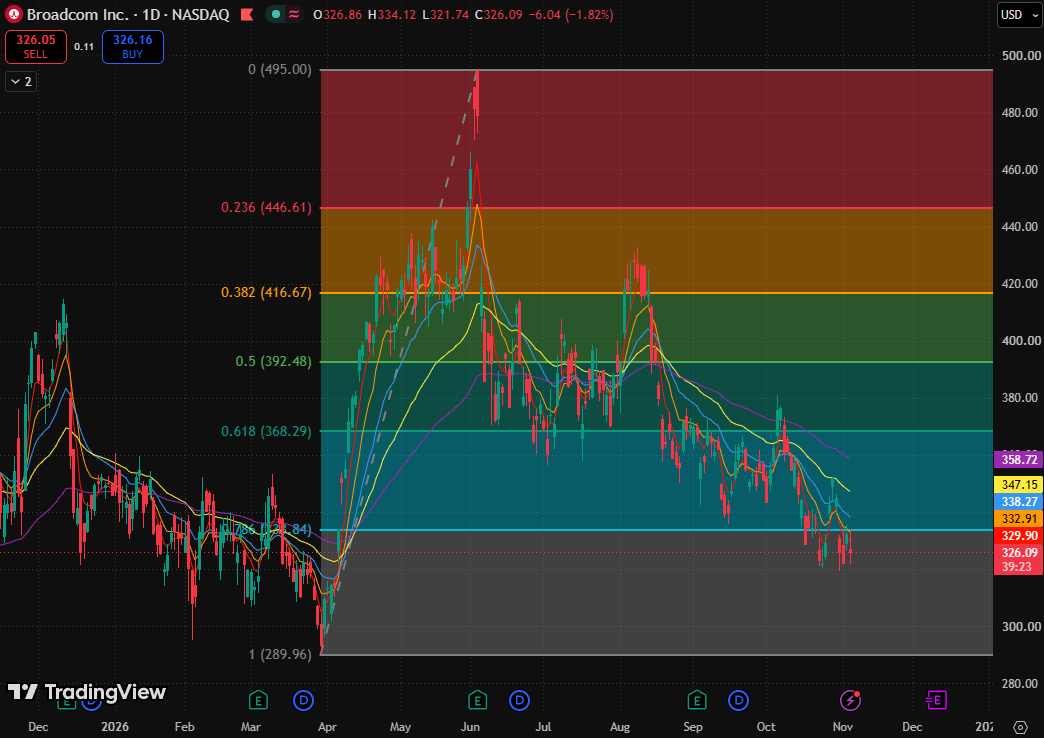
Broadcom stock chart, Source: TradingView
Regarding moving averages, short-term moving averages have converged during the recent rebound, but their relative alignment has not yet strengthened. The 80-day exponential moving average ($347.15) and 160-day exponential moving average ($358.72) also continue to exert downward pressure. The five moving averages ascend in sequence from shorter to longer timeframes, maintaining a complete bearish alignment, while both short- and medium-term trajectories remain weak.
In terms of rebound room, only if the stock price establishes a solid footing in the $332.91–$333.84 range and subsequently finds support on a pullback will the conditions for a sustained recovery be met; the stock could then further recover toward the $338.27–$347.15 zone formed by the 20-day exponential moving average and the 80-day exponential moving average.
If the stock decisively breaks below the recent low zone near $320 and fails to reclaim it on a rebound, the current consolidation will shift into a downside breakdown, potentially dropping toward the late-March low ($289.96).
Find out more