According to documents filed with the U.S. Securities and Exchange Commission on Tuesday morning, TSMC, the global chip manufacturing giant known as the "King of Chip Foundries", has approved a capital expenditure injection of up to $20 billion for its state-of-the-art chip manufacturing plant in Arizona, the United States.
Such hefty capital outlays will not only aggressively expand production capacity for AI chips and 2.5D/3D advanced packaging, but also build long-term competitive moats for future 3nm, 2nm and next-generation process platforms, delivering a strategic boost to its core competitiveness.
Accordingly, capacity expansion moves by chipmakers serve as a crucial catalyst for semiconductor equipment leaders, including ASML which supplies EUV lithography machines, as well as enterprises focusing on advanced process technologies such as etching, thin-film deposition and CMP.
TSMC Arizona, a wholly-owned subsidiary of TSMC based in Phoenix, Arizona, is developing a large-scale semiconductor manufacturing hub in Phoenix. TSMC has previously approved a massive investment of $165 billion for the project.
The base is planned to house six large-scale semiconductor wafer fabs, two advanced packaging facilities and a comprehensive R&D center. TSMC’s management stated that this project represents the largest foreign direct investment in a greenfield project in U.S. history.
In October 2025, the plant commenced mass production of NVIDIA’s (NVDA.US) flagship Blackwell architecture AI GPU using the advanced N4P process technology. The company targets mass production of the N3 process, equivalent to the 3nm node, in the second half of 2027. Its N2 and A16 advanced process technologies are expected to be deployed for chip manufacturing and advanced packaging capacity by 2030.
In addition, TSMC’s board of directors approved a capital budget of approximately $31.28 billion on Tuesday. The funds will be allocated to the capacity expansion of advanced chip manufacturing technologies, wafer fab construction and infrastructure system installation.
The move aims to accommodate the exponential growth in AI computing demand in recent years, driven by capacity expansion plans for AI computing infrastructure led by major clients including NVIDIA, AMD and Broadcom. Meanwhile, the board approved a cash dividend of $0.22 per share for the first quarter of 2026, scheduled for payment on October 8, 2026, in accordance with TSMC’s official announcement.
The Global Chip Bottleneck Evolves Into an Unprecedented Strategic Opportunity for TSMC
Within the global AI computing industrial chain, TSMC’s chip manufacturing capability has become the most scarce and critical resource.
U.S. tech giants including Microsoft, Meta, Google under Alphabet, and Amazon have collectively pushed their annual capital spending to nearly $800 billion, largely allocated to the construction of AI computing infrastructure.
As the primary manufacturer of nearly all cutting-edge AI chips and high-performance computing chips for data centers, TSMC’s production capacity for leading-edge processes including 3nm, 2nm and the upcoming N2 node has long operated at full load with oversubscribed bookings.
The supply-demand imbalance has turned its irreplaceable manufacturing strength into a bottleneck node for the entire industry.
Unlike conventional memory chips or general-purpose logic chips, wafers for AI accelerators, ASICs and multi-core data center CPUs that undertake AI inference and training workloads require extremely high technical standards in design, photolithography, interconnection and high-bandwidth packaging, with limited production lines and slow capacity expansion.
TSMC’s long-standing global leadership has established it as a hub and powerhouse of the advanced chip supply chain. Amid the unprecedented AI infrastructure boom, TSMC’s U.S.-listed ADR (TSM.US) has entered a long-term bull market, surging by an impressive 150% over the past year with a market capitalization exceeding $2 trillion.
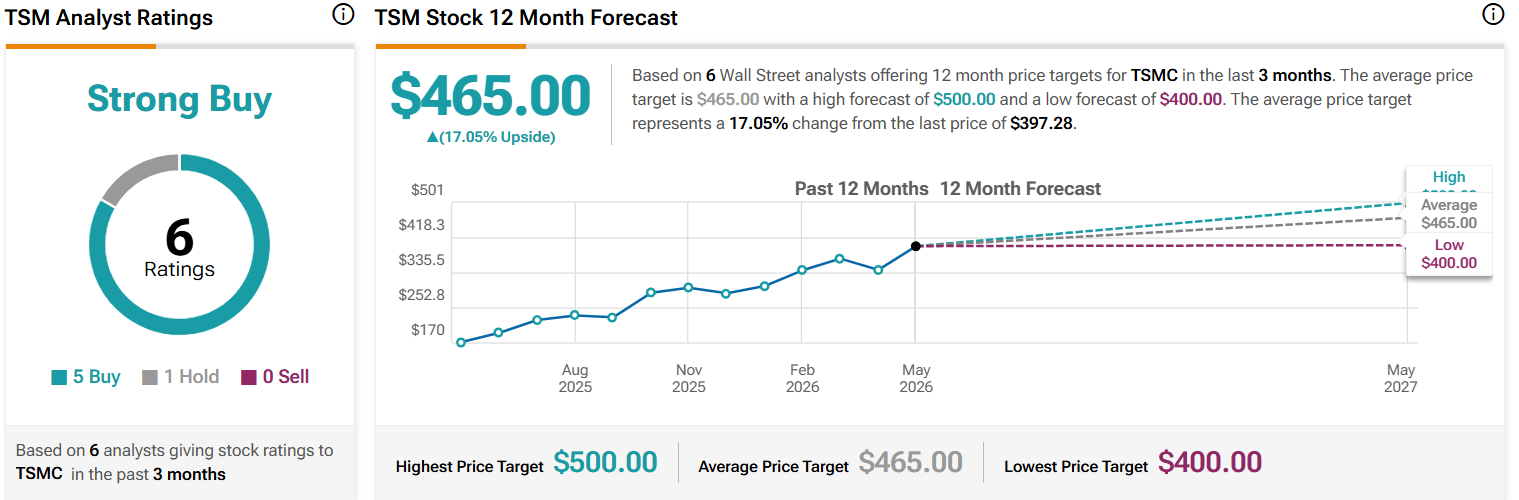
TSMC faces virtually no direct competitors in the 3nm leading-edge process segment. Samsung boasts strengths in memory chips and mature process nodes, yet lags far behind TSMC in production capacity and market share at the 3nm and 2nm nodes.
Intel’s foundry business is still in the incubation stage, while emerging wafer fabs in Japan and the U.S. will take several years to achieve stable mass production.
This supply-demand mismatch grants TSMC strong pricing power and capacity allocation authority among clients. Some customers have been forced to reserve production capacity years in advance and even make prepayments to lock in future output, a rare scenario in the history of the global semiconductor supply chain.
To meet the robust and rapidly expanding demand for AI computing, TSMC has embarked on record-breaking capacity expansion in recent years. It has maintained a record capital expenditure scale of $52 billion to $56 billion for 2026, and additionally approved a $20 billion capital injection into its wholly-owned Arizona subsidiary to accelerate the construction of leading-edge process capacity and supporting infrastructure for large-scale chip fabs.
These moves reflect TSMC’s comprehensive global capacity expansion strategy: it is ramping up advanced process production lines in Taiwan, China, while accelerating the layout of high-end manufacturing and advanced packaging capabilities in the U.S. The company plans to complete its advanced packaging plant by 2029 to ease the tight global chip supply.
Strategically, such intensive capital spending is not merely for capacity expansion, but also for building long-term competitive moats for future 3nm, 2nm and next-generation process platforms, effectively strengthening its overall core competitiveness.
Multiplier Effect Driven by the AI Bull Market Narrative: TSMC’s Capacity Expansion Surges Semiconductor Equipment Demand
Global demand for AI computing infrastructure and enterprise-grade storage chips in data centers continues to grow exponentially, with supply far outpaced by surging demand.
This trend is clearly evidenced by TSMC’s robust earnings performance and better-than-expected capital expenditure guidance, as well as the strong upward earnings outlook released by global semiconductor equipment leaders such as Applied Materials and Lam Research.
TSMC’s newly disclosed expansion in capital expenditure and production capacity directly benefits semiconductor manufacturing equipment suppliers and packaging equipment vendors.
The expansion of wafer fabs and advanced packaging lines requires massive procurement of EUV lithography machines, thin-film deposition systems, etching equipment and other core products from industry giants including ASML, Applied Materials, Lam Research and KLA Corporation.
TSMC’s global capacity expansion directly drives equipment demand, generating tangible order growth catalysts for equipment suppliers and fueling earnings expansion and capital expenditure recovery across the entire advanced semiconductor equipment supply chain.
Major Wall Street financial institutions have recently released research reports stating that the semiconductor equipment sector stands among the biggest beneficiaries of skyrocketing AI computing and storage demand.
The booming construction of ultra-large-scale global AI data centers led by tech giants including Microsoft, Google and Meta is comprehensively accelerating the capacity expansion of leading chipmakers in 3nm-and-below advanced process AI chips, CoWoS/3D advanced packaging, as well as DRAM and NAND storage chips.
The long-term bullish logic for the semiconductor equipment sector has become increasingly solid.
The unprecedented AI infrastructure boom and storage supercycle have propelled the semiconductor industry into a new phase characterized by material intensity, process control intensity and forward-shifted packaging technology.
Three major trends are reshaping the industry: the integration of 3D structures and new materials on the logic chip side; HBM stacking and interconnection upgrading on the storage side; and the conversion of system performance into manufacturing complexity via CoWoS and hybrid bonding on the packaging side.
These forces have collectively elevated the value density of key links including deposition, etching, CMP, advanced packaging and critical metrology, transforming semiconductor equipment demand from cyclical volatility into a structural super expansion cycle.