TradingKey - Alibaba begins the month of September at $118.90, where it closed August at $118.90, from the chart reference supplied. The rapid growth of AI Cloud is countered by the slower growth of the core commerce business and heavy spending on infrastructure. Free cash flow is being hurt the most. Spending on infrastructure has made a $10.2 billion equity placement to fund AI Cloud, but has increased the expected returns of this placement.
AI Cloud Growth Is Now the Core BABA Catalyst
Alibaba posted June quarter revenue of RMB 268.95 billion or $39.64 billion, an increase of 9% over the same quarter the previous year. Net income fell 75% to RMB 10.44 billion, and non-GAAP net income fell 38%, reflecting operating profits that were down, losses that were gains the previous year, decline in investment and a greater outflow for technology expenses.
The positive side of the results was seen in AI Cloud and Compute Services. Revenue climbed 45% to RMB 48.44 billion, and external cloud revenue grew 45%, while AI related products grew to RMB 12.38 billion with 12 consecutive quarters of triple digit growth and positive results.
AI Cloud adjusted EBITA grew 133% to RMB 5.63 billion. As such the cloud story is more compelling because Alibaba is more selective regarding spending to gain market share.
$10.2 Billion Share Sale Funds the Next AI Buildout
Alibaba completed its HK$80 billion equity placement on August 26, issuing 710 million new ordinary shares at HK$112.70. The new shares contained about 3.57% of the post-funding shares. One correction to the draft provided is of note: the placement price was a 8.4% discount to the last closing price of Alibaba's stock in Hong Kong.
The approximate net proceeds are HK$79.7 billion. Alibaba intends to use approximately 60% of the funds to enhance their global computing infrastructure, and 40% to develop hyperscale AI data centers in addition to upgrading their Agentic Cloud storage, database, and high-performance networking.
The dilution is substantial. However, the rationale is understandable. Alibaba is choosing to act now and inject compute alternatives before excess demand begins to create cloud service growth bottlenecks.
Qwen and Proprietary Chips Could Improve AI Economics
Alibaba is not just about deploying AI on their own cloud resources. Last month Alibaba launched their largest flagship model to date, Qwen3.8-Max, integrated with QwenWork, Alibaba’s enterprise AI-agent platform. Qwen3.8-Max has 2.4 trillion parameters.
Alibaba is also deploying T-Head’s proprietary chips across their GPUs, CPUs, storage and networking. Their Zhenwu M890 AI processor, adopted by Alibaba Cloud, has more than 650 external customers across more than 20 industries. Increasing the use of their own chips will reduce their reliance on more restricted foreign hardware and improve the economics of their infrastructure over time.
Management has indicated that the economic payback period on AI investments is moving towards 2.5 years, and they consider this an achievable target. Investors, however, are still waiting for evidence showing actual cash flows.
Commerce Remains Large, but Growth Is Uneven
Revenue for Alibaba’s E-commerce Group increased by 4% to RMB205.86 billion, but adjusted EBITA declined by 1%. In China, revenue from E-commerce also fell by 8% to RMB110.90 billion, and revenue from Customer Management services fell by 7% as well. Only the customer management revenue line would have grown by 1% on a comparable basis, were it not for the accounting effects from the new business development program.
China’s Quick Commerce improved by 45% to RMB53.30 billion, driven by Freshippo and Taobao Instant Commerce. International e-commerce declined by 1%, while global wholesale services grew by an impressive 7%. Chinese services are beginning to rely even more on AI Cloud for incremental growth, despite the dominance of Commerce in revenue and cash generation.
Free Cash Flow Is the Main Fundamental Risk
In the most recent quarter, Alibaba spent almost $10 billion on capital expenditures, a 75% increase year over year. Operating cash flow increased 11% to RMB 22.95 billion. However, Alibaba posted free cash flow of negative RMB 44.67 billion or negative $6.58 billion, attributed to incremental spending on cloud infrastructure.
That will likely be the largest concern with Alibaba for the month of September. The margins on cloud computing will need to improve and user spending on compute services will likely need to accelerate if Alibaba is to recoup the spending on their cloud infrastructure.
Alibaba Technical Analysis: $121.17 Is the Recovery Trigger
The supplied 2-hour chart places BABA at $118.88 and the latest session closed at $118.90. As the price holds above the $115.10-$115.17 support zone and trendline, the price structure is cautiously constructive. The first of the major hurdles is at $118.81 and is the 23.6% Fibonacci retracement level, which is above the first resistance. The 38.2% Fibonacci retracement level and the moving average are also in the range of $121.06-$121.17.
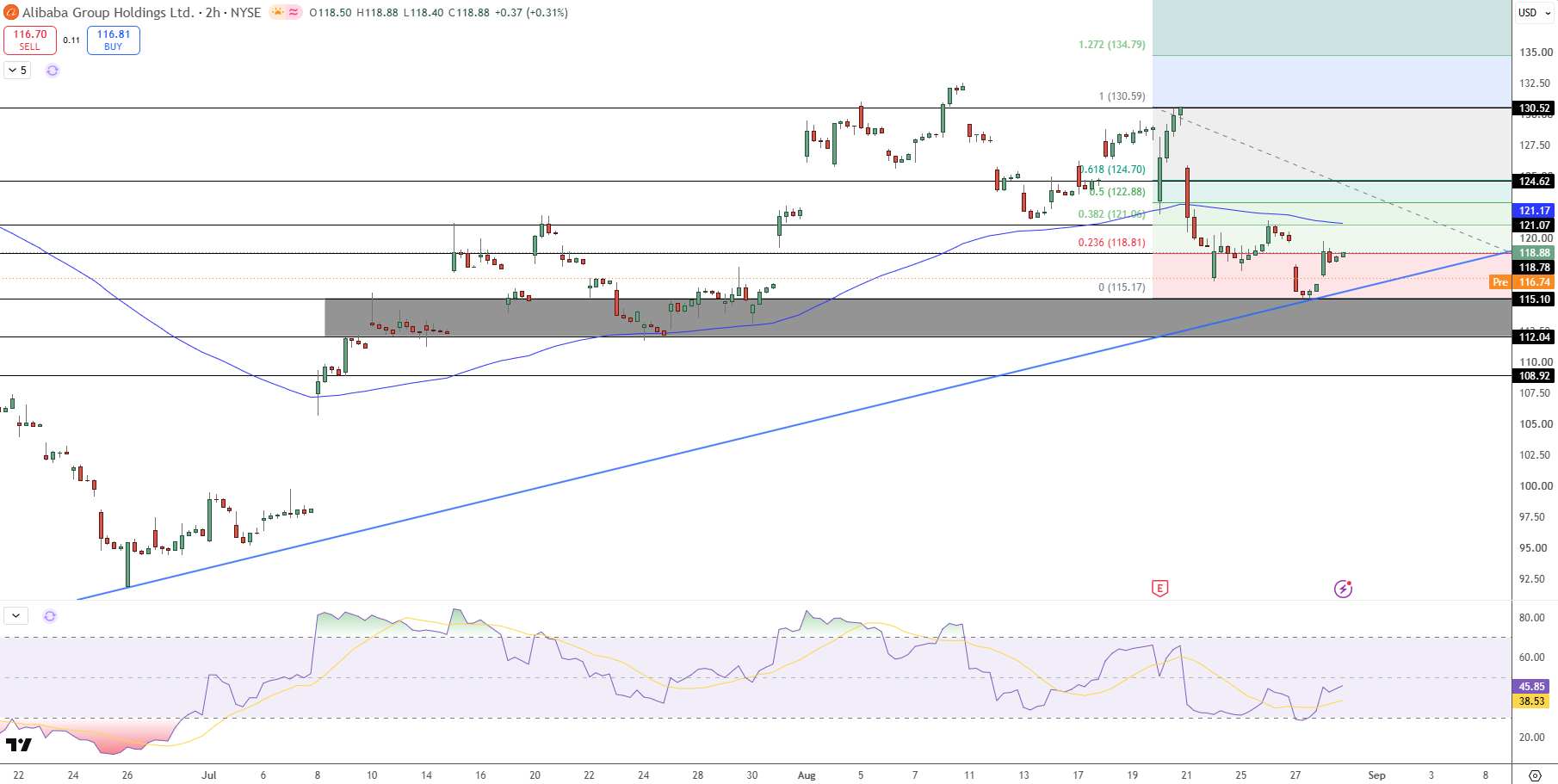
Alibaba Stock Price Chart - Source: Tradingview
An upside break through $121.17 will expose the next targets of $122.88, $124.62-$124.70, and $130.52. RSI is at 46 and is above the signal line of 39; this is currently a constructive recovery signal. If $115.10 breaks, the price may then continue to $112.04 and $108.92.
Key Levels
· Latest closed price: $118.90
· Primary Support: $115.10-$115.17
· Secondary Support: $112.04
· Breakout Resistance: $121.06-$121.17
· Upside Targets: $122.88, $124.62-$124.70, $130.52
· RSI: around 46
Why is Alibaba investing so heavily in AI?
As the growth in AI Cloud is 45% and the growth of AI products is over 100%, management is expanding data centers and networking to meet the demand; they are also investing in proprietary chips and Qwen models.
What level would strengthen the BABA recovery?
A break through the $121.17 resistance level will significantly positively impact the technical analysis of BABA as momentum would likely improve and push the price higher toward $124.62 and then upward to $130.52.
Bottom Line
Alibaba's traditional commerce business is headed for tougher times, but its AI story is taking off. The cloud business is growing and the AI Cloud is showing profits. The $10.2B placement leaves management with enough cash to fund their builds. This placement also causes significant dilution and negative free cash flow with capital expenditures of almost $10B in the latest quarter. BABA is constructive above $115.10, but for a more convincing recovery, $121.17 has to break first.
Find out more