PG&E Corp (PCG) moved down by 19.13%. The Utilities sector is down by 0.88%. The company underperformed the industry. Top 3 stocks by turnover in the sector: PG&E Corp (PCG) down 19.04%; Ge Vernova Inc (GEV) down 2.15%; Edison International (EIX) down 23.07%.
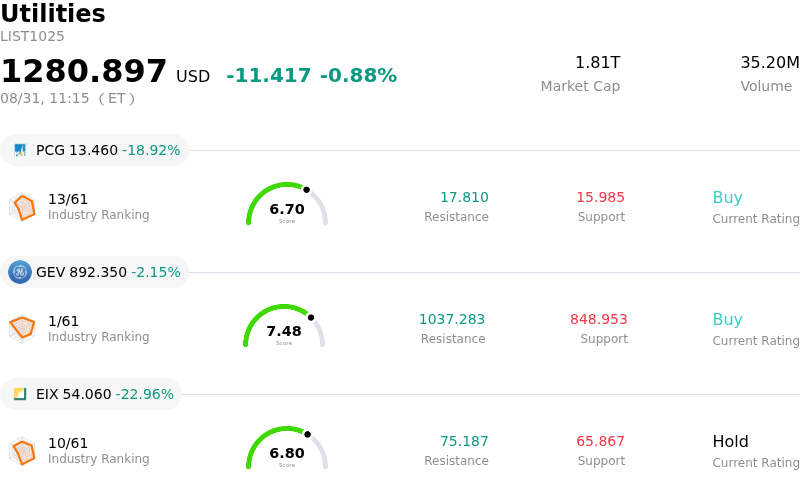
What is driving PG&E Corp (PCG)’s stock price down today?
Pacific Gas and Electric Company experienced a sharp decline following adverse legislative developments in California over the weekend. State lawmakers officially passed Senate Bill 492 while rejecting a key proposal supported by Governor Gavin Newsom that would have restricted insurance companies from pursuing subrogation claims against electric utilities for wildfire losses. The rejection of this protective clause leaves PG&E fully exposed to ongoing insurer lawsuits and open-ended financial liabilities whenever equipment-related fires occur, removing a critical legislative buffer that investors had anticipated.
Under the finalized language of Senate Bill 492, the state utility wildfire liability framework fails to provide a sustainable mechanism to replenish the ratepayer-funded wildfire fund once depleted. Furthermore, should the liability fund run dry, PG&E could be required to fund nearly half of any subsequent shortfall without the ability to pass those costs on to ratepayers. PG&E issued a public statement noting that while the bill makes incremental progress on disaster preparedness, it falls short of providing the structural liability reform necessary to secure affordable financing and protect utility capital structures over the long term.
The legislative outcome prompted an immediate wave of Wall Street downgrades and target price reductions. Major Wall Street brokerages, including Mizuho, BMO Capital, and Wells Fargo, downgraded the stock, citing unmitigated tail risk, heightened cost of capital, and potential erosion of book value. Analysts emphasized that despite PG&E delivering solid fundamental operational results and beating quarterly earnings expectations in recent periods, the company's leveraged balance sheet and negative free cash flow profile remain deeply vulnerable to catastrophic wildfire events, leading investors to reprice the equity across the broader California utility sector.
Technical Analysis of PG&E Corp (PCG)
Technically, PG&E Corp (PCG) shows a MACD (12,26,9) value of -0.631, indicating a neutral signal. The RSI at 22.565 suggests sell condition and the Williams %R at 93.139 suggests oversold condition. Please monitor closely.
Fundamental Analysis of PG&E Corp (PCG)
PG&E Corp (PCG) is in the Utilities industry. Its latest annual revenue is $24.93B, ranking 8 in the industry. The net profit is $2.59B, ranking 10 in the industry. Company Profile
Over the past month, multiple analysts have rated the company as Buy, with an average price target of $22.56, a high of $28.00, and a low of $19.00.
More details about PG&E Corp (PCG)
Company Specific Risks:
- Legislative Failure on Wildfire Protection Framework: California lawmakers rejected a key proposal to shield utilities from insurer subrogation claims, passing Senate Bill 492 without expected per-event liability caps or permanent backstops. Under the current setup, PG&E remains exposed to open-ended wildfire subrogation lawsuits and is legally required to fund nearly 48% of any future replenishment for the state wildfire liability fund without passing those costs to ratepayers.
- Widespread Wall Street Analyst Downgrades: Multiple institutional research firms—including Wells Fargo, BMO Capital Markets, and Mizuho Securities—downgraded PCG following the legislative setback. Analysts highlighted unquantifiable long-term tail risks, with BMO expanding its estimated wildfire liability valuation drag on PG&E from $6 to $10 per share and Wells Fargo pointing to California's value-destructive regulatory environment.
- Severe Balance Sheet Leverage and Credit Rating Exposure: PG&E carries over $62 billion in long-term debt and total liabilities exceeding $108 billion against a fragile interest coverage ratio below 2.0x. Massive capital expenditures toward grid safety keep free cash flow in negative territory, raising concerns that higher borrowing costs and potential credit rating downgrades will further inflate debt servicing costs.
- Capital Allocation and Shareholder Value Impairment: Open-ended liability exposure and high capital intensity constrain management's ability to maintain rate-base growth without pressuring the balance sheet. To avoid balance sheet distress or severe share dilution, PG&E may be forced to moderate capital investment plans, directly impairing long-term earnings growth visibility and cash returns to shareholders.
Find out more