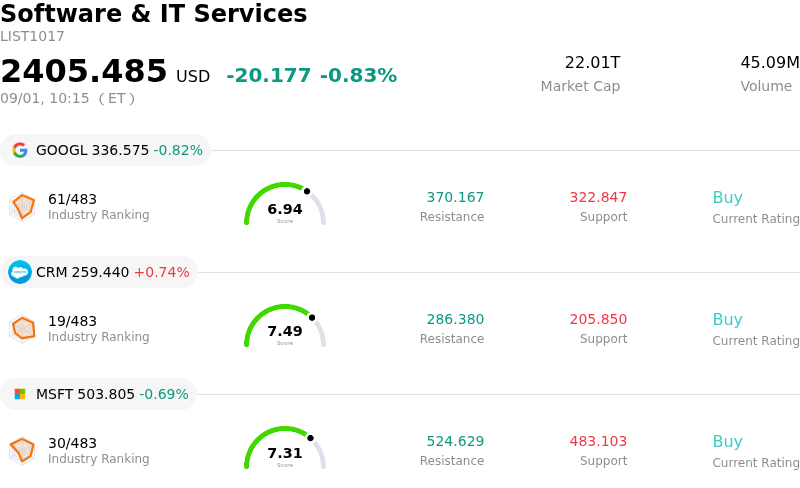
Shopify Inc (SHOP) moved down by 3.64%. The Software & IT Services sector is down by 0.83%. The company underperformed the industry. Top 3 stocks by turnover in the sector: Alphabet Inc Class A (GOOGL) down 0.78%; Salesforce Inc (CRM) up 0.74%; Microsoft Corp (MSFT) down 0.69%.
What is driving Shopify Inc (SHOP)’s stock price down today?
Shopify experienced noticeable downward momentum and heightened intraday volatility as market participants engaged in profit-taking following an extended multi-week rally. With no fresh corporate announcements or fundamental downgrades on the wires, the decline reflects standard momentum digestion and institutional rebalancing after a powerful post-earnings advance. Investors who drove the stock higher following stronger-than-expected quarterly revenue, gross merchandise volume, and free cash flow results are harvesting gains, leading to increased intraday price swings.
The pullback highlights the stock's sensitivity to broader equity market flows and valuation metrics. Trading at a premium multiple relative to software and e-commerce sector averages, Shopify remains inherently susceptible to short-term pullbacks when growth momentum in tech equities pauses. High-beta growth equities often experience magnified fluctuations during periods of sector-wide risk adjustments or macro yield shifts, as traders reduce exposure to higher-multiple assets in favor of defensively valued peers.
From a fundamental perspective, market participants are weighing Shopify's long-term growth opportunities against operational cost dynamics. Strong expansion in business-to-business commerce and native artificial intelligence integration, such as the Sidekick merchant assistant, continue to reinforce its platform dominance. However, ongoing capital allocation toward AI infrastructure and a revenue mix shifting toward payment solutions introduce short-term considerations regarding gross margin expansion and expense discipline.
For institutional investors, current trading activity appears driven primarily by technical profit-taking and portfolio repositioning rather than a breakdown in core business fundamentals. Attention remains focused on merchant order trends, consumer discretionary strength, and execution against full-year operating targets as the platform prepares for upcoming seasonal retail volume.
Technical Analysis of Shopify Inc (SHOP)
Technically, Shopify Inc (SHOP) shows a MACD (12,26,9) value of -3.182, indicating a neutral signal. The RSI at 49.063 suggests neutral condition and the Williams %R at 96.128 suggests oversold condition. Please monitor closely.
Fundamental Analysis of Shopify Inc (SHOP)
Shopify Inc (SHOP) is in the Software & IT Services industry. Its latest annual revenue is $11.56B, ranking 32 in the industry. The net profit is $1.23B, ranking 40 in the industry. Company Profile
Over the past month, multiple analysts have rated the company as Buy, with an average price target of $171.15, a high of $220.00, and a low of $110.00.
More details about Shopify Inc (SHOP)
Company Specific Risks:
- Institutional and Insider Stake Divestments: Recent market data highlights substantial share liquidations by prominent insiders, including Chief Operating Officer Jessica Hertz, alongside major institutional stake reductions such as ICONIQ Capital trimming its position, heightening market anxiety regarding executive confidence and driving sell-offs.
- Elevated Valuation Multiples and Profit-Taking Volatility: Trading at extreme valuation metrics, including a trailing price-to-earnings ratio near 100x and a forward price-to-sales ratio exceeding 11x, Shopify remains acutely vulnerable to sharp profit-taking and sector-wide growth stock drawdowns following recent multi-week rallies.
- Competitive Disruption from Generative AI Ecosystems: Wall Street research emphasizes growing disintermediation threats from tech major integrations, particularly Meta Platforms rolling out AI-driven merchant tools for small businesses, which could undermine Shopify's core merchant acquisition and retention rates.
- Margin Compression from Unfavorable Revenue Mix: A continuing shift toward lower-margin merchant solutions, such as Shopify Payments, combined with increased credit and lending risks and escalating infrastructure expenses for large language model implementations, continues to weigh on gross profit expansion.
Find out more