USD/CHF (USDCHF) is up 0.50% at Sep 24 11:05(ET), now at $0.82915, with a 7-day up of 0.60%.
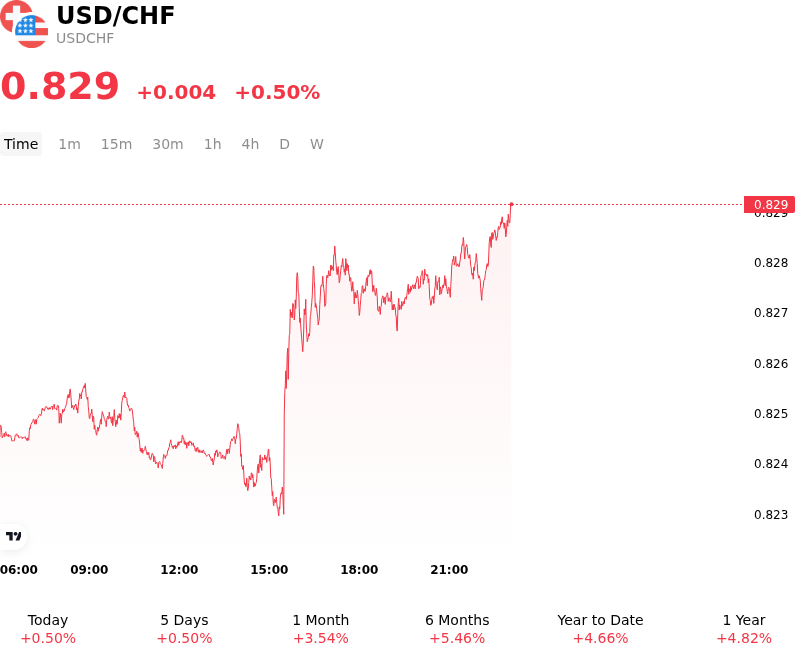
What is driving USD/CHF (USDCHF)’s stock price up today?
The Swiss Franc underperformed relative to the US Dollar following the Swiss National Bank's quarterly monetary policy assessment, where policymakers kept the benchmark policy rate unchanged at zero percent. Although the rate pause was widely anticipated, market participants reacted to subtle changes in the central bank's policy statement. The SNB softened its language regarding foreign exchange market intervention, removing previous references to an increased willingness to intervene in favor of standard commentary. This adjustment signaled to investors that the central bank views previous Swiss Franc overvaluation risks as largely resolved, diminishing short-term safe-haven support for the currency and triggering a sell-the-fact reaction across Swiss Franc pairs.
The persistent monetary policy divergence between the Federal Reserve and the Swiss National Bank continues to exert upward pressure on the currency pair. While the SNB opted to maintain a zero interest rate environment, expectations for additional Federal Reserve policy tightening reinforced US yields. Recent solid US economic indicators, including strong manufacturing activity, alongside elevated energy prices, have cemented market expectations that the Federal Reserve will maintain a higher-for-longer rate trajectory or deliver additional rate increases. Consequently, the widening short-term yield differential between US Treasuries and Swiss Confederation bonds continues to incentivize capital allocation into Dollar-denominated fixed income assets at the expense of zero-yielding Swiss Franc holdings.
From a broader macro perspective, global energy market volatility and elevated oil prices present differing challenges for both central banks. Although the SNB revised its near-term inflation projections slightly upward, policymakers emphasized that underlying domestic price pressures remain firmly within their target band of price stability, reducing the immediate urgency for interest rate hikes in Switzerland. Conversely, energy-driven inflation risks in the United States keep Federal Reserve hawkishness alive, sustaining strong underlying momentum for the greenback. Barring a sudden spike in risk aversion that reignites safe-haven demand for the Swiss Franc, the path of least resistance for the pair remains supported by fundamental interest-rate differentials and diverging monetary policy stances.
Technical Analysis of USD/CHF (USDCHF)
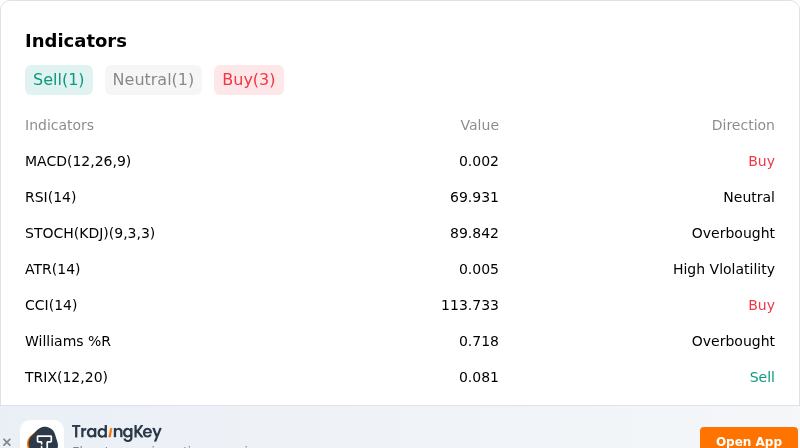
Technically, USD/CHF (USDCHF) shows a MACD (12,26,9) value of 0.002, indicating a buy signal. The RSI at 69.931 suggests neutral condition and the Williams %R at 0.718 suggests overbought condition. Please monitor closely.
More details about USD/CHF (USDCHF)
Recent Events and Risks:
- SNB Foreign Exchange Intervention Threat: Following its decision to maintain policy rates at 0%, the Swiss National Bank explicitly reaffirmed its willingness to intervene actively in foreign exchange markets, creating immediate two-way intraday volatility and downside risk for USD/CHF if policymakers move to stem Franc weakness.
- Technical Overbought Conditions and Resistance Reversal: USD/CHF's rapid rally to multi-month highs near 0.8275 has met strong structural resistance around 0.8260–0.8280, where overbought RSI signals leave the pair highly susceptible to sudden profit-taking and sharp downside pullbacks.
- Upward Inflation Revisions and Hawkish Re-pricing: The SNB revised its medium-term inflation forecasts higher through 2028 due to elevated energy costs, spurring market expectations for potential policy tightening by late 2026 or 2027, which risks driving renewed buying interest into the Swiss Franc.
- Geopolitical Risk Off and Safe-Haven Spikes: Broad economic uncertainty and escalating Middle East conflict risks keep the currency pair vulnerable to sudden liquidity shifts, as flare-ups in global risk aversion tend to trigger aggressive safe-haven flows directly into the Swiss Franc.
Find out more