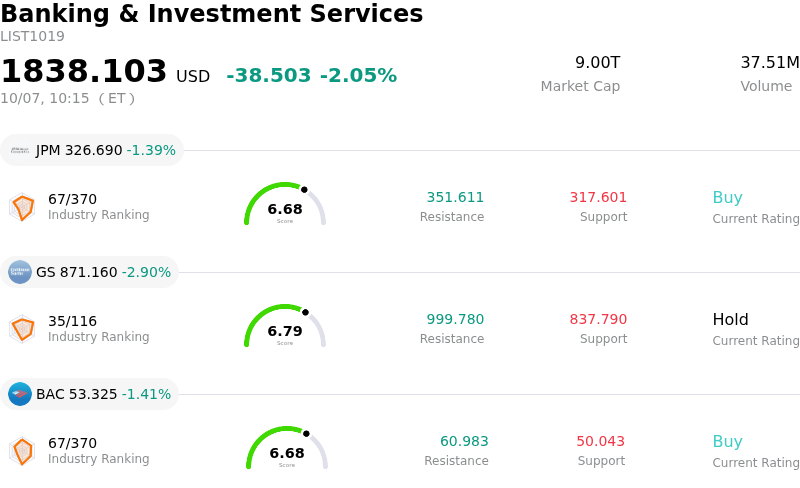
Mitsubishi UFJ Financial Group Inc (MUFG) moved down by 3.10%. The Banking & Investment Services sector is down by 2.05%. The company underperformed the industry. Top 3 stocks by turnover in the sector: JPMorgan Chase & Co (JPM) down 1.39%; Goldman Sachs Group Inc (GS) down 2.90%; $Bank of America Corp(BAC-N)$ (BAC) down 1.37%.
What is driving Mitsubishi UFJ Financial Group Inc (MUFG)’s stock price down today?
Mitsubishi UFJ Financial Group experienced downward pressure during the trading session, driven primarily by shifting expectations surrounding Japanese monetary policy and broader financial sector profit-taking. Public remarks from Bank of Japan officials signaled a cautious approach toward further interest rate adjustments, dampening market expectations for immediate follow-up rate hikes. Because domestic mega-banks rely on rising interest rates to expand net interest margins and boost interest income, any indication of a measured policy trajectory directly tempers immediate earnings acceleration expectations for major Japanese lenders.
In addition to domestic monetary policy dynamics, global macroeconomic headwinds and bond yield fluctuations weighed on institutional sentiment. Global financial equities faced profit-taking following a period of strong year-to-date performance across the sector. Fluctuations in benchmark bond yields and foreign exchange rates created additional volatility for international banking franchises. As a global institution with extensive commercial and investment banking operations worldwide, shifting yield curves and global economic uncertainty prompted institutional investors to adjust portfolio allocations away from financial ADRs.
Despite short-term volatility, the company's long-term operational thesis remains supported by its strong market franchise, ongoing capital optimization, and strategic investments in digital infrastructure and international growth. While near-term trading activity reflects macroeconomic repricing and interest rate sensitivity, institutional focus will remain on the central bank's policy path, overall net interest margin trajectories, and upcoming financial results.
Technical Analysis of Mitsubishi UFJ Financial Group Inc (MUFG)
Technically, Mitsubishi UFJ Financial Group Inc (MUFG) shows a MACD (12,26,9) value of -0.177, indicating a neutral signal. The RSI at 43.988 suggests neutral condition and the Williams %R at 79.710 suggests sell condition. Please monitor closely.
Fundamental Analysis of Mitsubishi UFJ Financial Group Inc (MUFG)
Mitsubishi UFJ Financial Group Inc (MUFG) is in the Banking & Investment Services industry. Its latest annual revenue is $42.22B, ranking 10 in the industry. The net profit is $11.47B, ranking 8 in the industry. Company Profile
Over the past month, multiple analysts have rated the company as Strong Buy, with an average price target of $26.53, a high of $26.53, and a low of $26.53.
More details about Mitsubishi UFJ Financial Group Inc (MUFG)
Company Specific Risks:
- Domestic Yield Volatility and Sovereign Bond Mark-to-Market Risk: Sharp fluctuations in Japanese Government Bond yields and global fixed-income markets create unrealized loss exposure and hedging friction within MUFG's extensive bond holdings, driving intraday ADR volatility.
- Global Rate Easing and Medium-Term Earnings Growth Compression: Lowering interest rates by foreign central banks and revised analyst estimates point to potential net interest margin degradation across international units, threatening to slow fiscal net profit growth to lower single-digit percentages.
- Cross-Border Credit Risk and FX Sensitivity: Massive exposure to overseas operations, including joint ventures like Morgan Stanley and commercial lending subsidiaries across Asia-Pacific, subjects MUFG's balance sheet to cross-border credit risks, currency fluctuations, and geopolitical headwinds in international debt markets.
- Volume-Price Divergence and Technical Downside Pressure: Recent intraday trading shows negative momentum signals and a divergence between declining trading volume and price movements, indicating weak institutional buying interest and leaving the stock susceptible to tests of key downside support levels.
Find out more