SpaceX (NASDAQ: SPCX) now builds and launches rockets, provides satellite connectivity, offers launch services, has a national security business, and is rapidly growing its AI business. Investors can now access all these businesses through a single publicly traded company for the first time. As of the close on 10/2/26, SPCX was valued at $158.96 a share, approximately 18% above its June IPO price of $135 and roughly 7.35% higher than its close on 10/1/26, but far below its post-IPO 52-week high of $225.64.
I find it interesting that SpaceX has strong operating momentum while extremely heavy capital requirements. Starlink’s Connectivity segment is producing operating income, while SpaceX’s AI segment generated positive adjusted EBITDA in Q2 but remained loss-making on a GAAP operating basis. Starship remains in a development-heavy phase. On the other hand, the company reportedly spent over $18 billion on capital expenditures in Q2. Investors are left to decide if and when the various business units of SpaceX will scale to justify the extreme capital intensity and roughly $2.2 trillion market cap.
Starship Flight 14 Marks a Major Orbital Milestone
Flight 14 was the first successful Starship mission to deliver a meaningful payload to orbit. The mission’s overall success was limited by an engine issue that cut the mission short and prevented completion of other planned objectives.
This has one important clarification. Flight 13, the previous test, deployed 20 production V3 satellites on a suborbital test trajectory with Starship in July. So, Starship 14 was not the first time Starship deployed production V3 hardware. What made Starship 14 special was the orbit and payload delivery component, which is a much bigger deal for StarLink’s overall economic viability.
The orbit and payload delivery component made Starship 14 much more special than previous test flights, but the mission was far from perfect. SpaceX has said that one of the Super Heavy Raptor engines had shut down during ascent. Reuters also reported an unexpected engine shutdown during the mission. The propulsion issues remain under investigation, meaning development risk remains very much alive. I would say that because of NASA’s reliance on Starship for lunar missions, Flight 14 is more of a major technology breakthrough than a proof of concept of operational readiness.
Starlink Has Become the Financial Engine
SpaceX’s Q2 results show the increasing importance of Starlink to the company’s finances. Connectivity revenue jumped 66% year over year to $4.291 billion, and operating income jumped 79% to $1.656 billion. Adjusted EBITDA for the connectivity segment was $2.597 billion, by far the strongest of the operating segments.
Starlink finished the quarter with 12 million subscribers, twice the six million a year earlier and up from 10.3 million in the prior quarter. Average monthly revenue per user stayed the same at $66, and is notable because with rapid international expansion, the user mix can include lower-priced markets, pressuring average revenue per user. Consumer connectivity revenue was $2.485 billion, while revenue for connectivity services offered to governments and enterprises more than doubled to $1.806 billion.
The combination of increasing Starlink subscriber numbers, as well as increasing government and enterprise connectivity revenue, is the primary focus for the stock. The maritime and aviation markets are also showing opportunity for mobile and connectivity services. While the consumer broadband market may become saturated, SpaceX has many opportunities to keep the connectivity business growing.
Starshield Deepens Government Exposure
SpaceX said it had been awarded more than $6 billion of multi-year U.S. government contracts for Starshield, its secure satellite communications system. The company said the awards were primarily driven by two contracts for the Space Force for low-Earth-orbit communications and sensing constellations.
SpaceX separately reports consumer and enterprise/government Starlink connectivity revenue, while Starshield is its secure satellite network designed specifically for government customers and national-security applications. Perhaps, government contracts can give SpaceX stable, long-term revenues. Starlink is, arguably, the most important space-based communications system for the U.S. defense department. Other contracts can lead to more SpaceX relationships with the U.S. defense department.
Defense contracts can bring SpaceX stable, long-term revenue and strengthen its relationships with the U.S. defense department. SpaceX’s trade-off for these contracts can be burdensome and lengthy regulations and a stiff U.S. defense department oversight.
SpaceX, also, listed an SDA Tranche 1 mission for October 5 from Vandenberg to launch 21 Northrop Grumman satellites for a military communications constellation. A live launch source was still showing that mission to be scheduled and “go” around the publication time. Thus, I will not say that mission is complete until SpaceX confirms it.
AI Is Now a Real Revenue Segment
The structural change in SpaceX's story may be AI. During the second quarter of 2026, SpaceX generated $2.561 billion in revenue from AI, up 247.5% from the second quarter of 2025. In the first six months of 2026, SpaceX generated $3.379 billion from AI. The main drivers of revenue growth in Q2 were new Cloud Services Agreements, AI solutions and infrastructure revenue, and higher Grok and X subscription revenue.
Adjusted EBITDA for the AI segment was $1.146 billion for Q2, a dramatic improvement from a loss in the same period of the previous year. However, GAAP operating loss was $1.257 billion. Heavy R&D and other operating costs remained high, while depreciation and share-based compensation explain much of the gap between GAAP operating income and adjusted EBITDA. That GAAP operating loss shows the company should be valued by both revenue and capital intensity.
As of the end of Q2, SpaceX had 1.4 gigawatts of nameplate AI compute capacity, up from 1 gigawatt in Q1, and 0.4 GW in Q2 of the previous year. SpaceX also has signed $14.1 billion of cloud services contracts. Those contracts give visibility to the AI segment, but ultimately return will depend on how well the company charges for and utilizes the hardware.
AI Capex Is the Biggest Financial Risk
Total capex for Q2 was $18.369 billion, with $15.828 billion allocated to AI. For the first six months of 2026, SpaceX invested $23.551 billion in AI. The massive capital investment is the main reason SpaceX’s cash requirements are so high even while adjusted EBITDA is strong; capex itself does not directly create the GAAP operating loss.
This is the main point of contention for most potential investors. The AI segment has clearly been monetizing compute this year, but investors are still asked to underwrite large spending in the near-term to achieve long-term returns. If cloud contracts are executed as planned, the economics could vastly improve. If not, the downside is large, because the fixed-cost base is already large.
Renaming the AI segment as SpaceXSI is financially unremarkable, as compared to the other changes announced by Musk. On October 4, he announced the change, but gave no time frame on when it would occur. From a financial perspective, I would consider this branding more than a potential catalyst.
The IPO and Bond Deal Provide a Huge Capital Cushion
SpaceX went public in June at $135 per share. The company sold 638,888,888 Class A shares after the underwriters exercised their full option, raising approximately $85.7 billion in gross proceeds according to SpaceX’s investor-relations release. The company said it intended to use the IPO proceeds to expand AI compute infrastructure, launch systems and satellite capacity.
SpaceX then issued $25 billion of senior unsecured notes across five maturities ranging from 2031 to 2056. The weighted average interest rate was about 5.855%, and proceeds were used to repay bridge financing, cover fees and support general corporate purposes. That financing gives the company an unusually large capital cushion as it funds Starship, Starlink and AI simultaneously.
The strength is obvious: SpaceX has access to both equity and debt markets at enormous scale. The risk is equally clear: investors are now exposed to a company that is willing to spend tens of billions before all of its growth businesses have reached mature economics. The balance between growth and capital discipline will matter more from here.
Valuation Assumes Multiple Businesses Succeed
As of October 2, SpaceX was valued at approximately $2.16 trillion in the equity markets. About a year’s worth of revenues was approximately $23.0 billion, and net income was still negative. According to Stock Analysis, forward P/E is approximately 100, indicating the high expectations investors have for SpaceX’s future profitability.
I also think the valuation requires Starlink to remain profitable and continue its rapid growth. There is also the bear case where Starship increases competition and slashes launch prices to undercut the competition. There is also an expectation by the market that SpaceX’s defense and intelligence contracts grow, and that SpaceX becomes a major player in the development and sale of AI. The expectation by the market is for multiple large and successful businesses.
SpaceX Technical Analysis: SPCX Breaks $157.85 as Bulls Target $172.03
SpaceX closed at $158.96 on October 2, up 7.35% on the day. The stock broke above its recent resistance at $157.85. The fact that the price is above both the 20 and 50 moving averages at $148.61 and $148.39 respectively and is also above the rising trend line from the lows of August means the upward trend and the larger bullish structure is still intact.
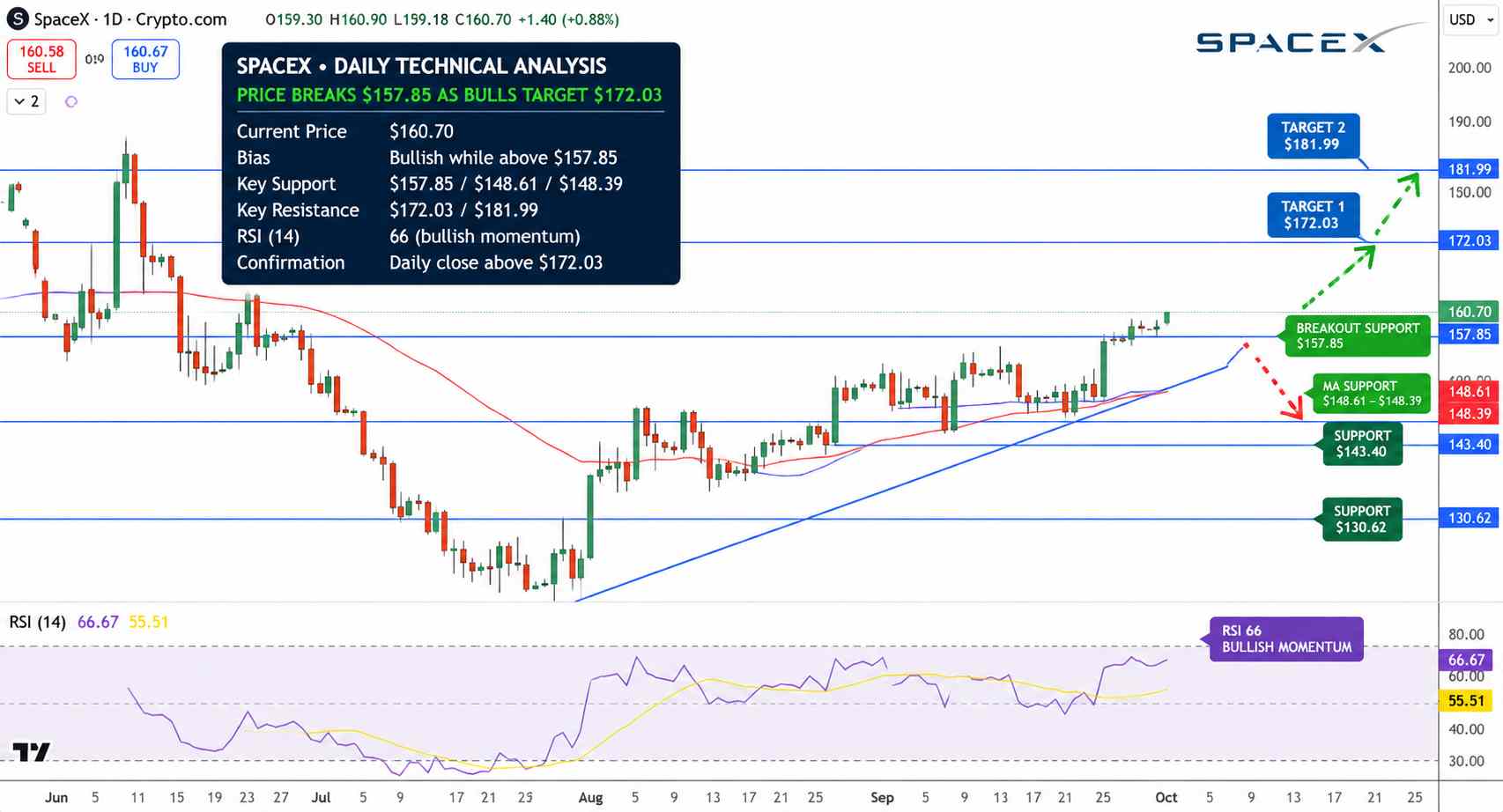
SpaceX Stock Price Chart - Source: Tradingview
RSI at 66, is above its signal line at 56 and is approaching overbought conditions. While it is not extremely overbought, there is some momentum in the price of the stock and a small pullback would not be surprising. The upside price target for the stock is $172.03.
A close above $172.03 would then expose the next resistance at $181.99 and a close below the $157.85 would first support the bearish case, with the moving averages at $148.61 and $148.39 coming into play next, followed by $143.40.
My base case remains bullish as long as SpaceX holds above $157.85, with $172.03 next major target.
Key Levels
- Latest completed close: $158.96
- Major support levels: $157.85, $148.61 to $148.39, then $143.40
- Major resistance levels: $172.03, $181.99, then the prior post-IPO highs
- RSI: approximately 66, bullish
- Breakout target: $172.03, $181.99
Why is SpaceX stock in focus now?
SpaceX is in the spotlight due to the 14th flight of Starship, which delivered a significant payload to orbit, the continued growth of Starlink, which crossed 12 million subscribers, Starshield contracts, and the rapid expansion of the AI business. However, that may not be enough to overshadow huge investments and a valuation that nearly prices success across multiple lines of business.
What level confirms a stronger SPCX breakout?
A daily close above $172.03 confirms the next bullish extension and increases the odds in favor of $181.99. A daily close below $157.85 increases the odds of a retest of the $148.61 to $148.39 dynamic support zone.
Bottom Line
SpaceX has a broader investment case than it had at the IPO, primarily due to the progress of Starship and Starlink and the work being done for government contracts. Starlink is already producing strong operating income. AI has turned positive on adjusted EBITDA but remains loss-making on a GAAP operating basis. The three reported business segments of SpaceX operate synergistically, so the potential upside is significant.
The risk is mainly capital intensity. SpaceX reported a GAAP operating loss in Q2 while capex remained extremely high; capex drives cash intensity but does not directly flow through operating profit. Technically, SPCX is bullish above $157.85, but the next phase of the story will be demonstrating the ability of Starlink, Starship and AI to produce enough cash to justify the current level of investments.
Find out more